Klassifizierung / Names
Namen | Synonyme | Catalog of Fishes(Gattung, Arten) | ITIS | CoL | WoRMS | Cloffa
>
Eupercaria/misc (Various families in series Eupercaria) >
Labridae (Wrasses) > Cirrhilabrinae
Etymology: Cirrhilabrus: Latin, cirrus = curl fringe + Greek, labros = furious (Ref. 45335); beauperryi: Named for Beau Perry, son of Claire and Noel Perry, supporters of Conservation International.
Eponymy: Named for Beau Perry, son of Claire and Noel Perry, supporters of Conservation International. (Ref. 128868), visit book page.
Umwelt: Milieu / Klimazone / Tiefenbereich / Verbreitungsgebiet
Ökologie
seewasser riff-verbunden; tiefenbereich 5 - 32 m (Ref. 90102), usually 6 - 12 m (Ref. 78106). Tropical
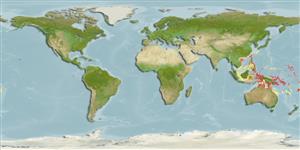
Western Pacific: Papua New Guinea and the Solomons.
Größe / Gewicht / Alter
Geschlechtsreife: Lm ? range ? - ? cm
Max length : 8.5 cm SL Männchen/unbestimmt; (Ref. 78106)
Kurzbeschreibung
Bestimmungsschlüssel | Morphologie | Morphometrie
Rückenflossenstacheln (insgesamt) : 11; Rückenflossenweichstrahlen (insgesamt) : 9; Afterflossenstacheln: 3; Afterflossenweichstrahlen: 9. This species has the following characters: D XI, 9; A III, 9; pectoral rays 15; lateral-line scales 14-17 + 6-9; median predorsal scales 6; cheek below eye with horizontal scale rows of 2; gill rakers 17-20; body depth 3.0-3.1 in SL; head length 3.1-3.3 in SL; snout length 3.6-4.0 in head; adult male with median head profile slightly concave at interorbital; rounded caudal fin; males with elongate and filamentous pelvic fins, reaching level of posterior half of anal fin; live colour pattern of terminal phase (male) includes a general purplish body, grading to blue ventrally and greenish or yellowish brown dorsally, with a broad purple stripe along the basal half of the otherwise pale yellow dorsal fin, and a thin purple bar across the violet-coloured pectoral-fin base; color in initial phase mainly dull purplish red with a small blackish spot on dorsal portion of caudal peduncle (Ref. 78106).
Body shape (shape guide): fusiform / normal; Cross section: compressed.
Found solitary or in groups in rubble areas near lagoons and seaward slopes (Ref. 90102).
Lebenszyklus und Paarungsverhalten
Geschlechtsreife | Fortpflanzung | Ablaichen | Eier | Fruchtbarkeit | Larven
Distinct pairing during breeding (Ref. 205).
Allen, G.R., J. Drew and P. Barber, 2008. Cirrhilabrus beauperryi, a new wrasse (Pisces: Labridae) from Melanesia. aqua, Int. J. Ichthyol. 14(3):129-140. (Ref. 78106)
IUCN Rote Liste Status (Ref. 130435: Version 2025-2 (Global))
Bedrohung für Menschen
Harmless
Nutzung durch Menschen
Tools
Zusatzinformationen
Download XML
Internet Quellen
Schätzungen auf der Grundlage von Modellen
Bevorzugte Temperatur (Ref.
123201): 27.4 - 29.3, mean 28.8 °C (based on 551 cells).
Phylogenetischer Diversitätsindex (Ref.
82804): PD
50 = 0.5000 [Uniqueness, from 0.5 = low to 2.0 = high].
Bayesian length-weight: a=0.01072 (0.00427 - 0.02691), b=3.03 (2.81 - 3.25), in cm total length, based on LWR estimates for this (Sub)family-body shape (Ref.
93245).
Trophische Ebene (Ref.
69278): 3.4 ±0.4 se; based on size and trophs of closest relatives
Widerstandsfähigkeit (Ref.
120179): hoch, Verdopplung der Population dauert weniger als 15 Monate. (Preliminary K or Fecundity.).
Anfälligkeit der Fischerei (Ref.
59153): Low vulnerability (10 of 100).
🛈
Nährstoffe (Ref.
124155): Calcium = 126 [72, 255] mg/100g; Iron = 0.97 [0.54, 1.89] mg/100g; Protein = 18.2 [15.2, 20.4] %; Omega3 = 0.17 [0.09, 0.30] g/100g; Selenium = 21.1 [11.3, 42.9] μg/100g; VitaminA = 287 [84, 1,051] μg/100g; Zinc = 1.95 [1.26, 3.10] mg/100g (wet weight);