Classification / Noms
Noms communs | Synonymes | Catalog of Fishes(Genre, Espèce) | ITIS | CoL | WoRMS | Cloffa
>
Siluriformes (Catfishes) >
Loricariidae (Armored catfishes) > Hypostominae
Etymology: Peckoltia: Because of Gustavo Peckolt,member of the Natural History Commission of Rondon (Ref. 45335); caenosa: From the Latin caenosus meaning muddy or dirty, in reference to the muddy coloration of this species and its preference for muddy habitats.
Eponymy: Gustavo Peckolt (1861–1923) was a Brazilian-born German botanist and pharmacist. [...] (Ref. 128868), visit book page.
Environnement : milieu / zone climatique / profondeur / gamme de distribution
Écologie
; eau douce benthopélagique. Tropical; 10°N - 6°N, 68°W - 59°W
South America: llanos of Venezuela in rivers draining into the middle Río Orinoco.
Taille / Poids / Âge
Maturité: Lm ? range ? - ? cm
Max length : 15.7 cm SL mâle / non sexé; (Ref. 77026)
Description synthétique
Clés d'identification | Morphologie | Morphométrie
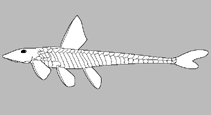
Épines dorsales (Total) : 2; Rayons mous dorsaux (Total) : 7; Épines anales: 1; Rayons mous anaux: 4. Distinguishes from its congeners by having dark vermiculations on the abdomen (vs. spots, long, fairly straight, wide lines, or plain); also from all congeners except Peckoltia bachi by having the dorsal and lateral surface of the body mottled (vs. with spots or saddles); and from P. bachi by having the spots on the head small (vs. large) and generally forming vermiculations (vs. separate), the pelvic spines narrow (vs. wide), and the eye high on the head (vs. low) (Ref. 77026).
Body shape (shape guide): elongated.
Facultative air-breathing in the genus (Ref. 126274); Inhabits slow-flowing muddy streams. Also encountered inside submerged, hollow logs during the day (Ref. 77026).
Cycle de vie et comportement reproducteur
Maturité | Reproduction | Frai | Œufs | Fécondité | Larves
Armbruster, J.W., 2008. The genus Peckoltia with the description of two new species and a reanalysis of the phylogeny of the genera of the Hypostominae (Siluriformes: Loricariidae). Zootaxa 1822:1-76. (Ref. 77026)
Statut dans la liste rouge de l'IUCN (Ref. 130435: Version 2025-2 (Global))
Menace pour l'homme
Harmless
Utilisations par l'homme
Outils
Articles particuliers
Télécharger en XML
Sources Internet
Estimations basées sur des modèles
Indice de diversité phylogénétique (Réf.
82804): PD
50 = 0.5000 [Uniqueness, from 0.5 = low to 2.0 = high].
Bayesian length-weight: a=0.01549 (0.00726 - 0.03306), b=2.96 (2.79 - 3.13), in cm total length, based on LWR estimates for this (Sub)family-body shape (Ref.
93245).
Résilience (Réf.
120179): Milieu, temps minimum de doublement de population : 1,4 à 4,4 années (Preliminary K or Fecundity.).
Vulnérabilité de la pêche (Ref.
59153): Low vulnerability (10 of 100).
🛈