>
Elopiformes (Tarpons and tenpounders) >
Elopidae (Tenpounders)
Etymology: Elops: Greek, ellops = a kind of serpent (Ref. 45335).
More on author: Regan.
Ambiente: milieu / zona climatica / distribuzione batimetrica / gamma di distribuzione
Ecologia
marino; acqua dolce; salmastro pelagic-neritic; anadromo (Ref. 51243); distribuzione batimetrica 1 - 30 m (Ref. 6898). Tropical; 41°N - 40°S, 92°E - 138°W
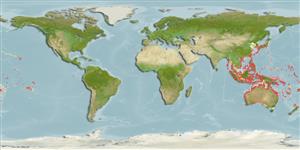
Indo-Pacific: from the Andaman Sea in the Eastern Indian Ocean to Western Australia and in the Pacific, from southern Japan to New South Wales and New Caledonia; throughout most of Oceania to the Hawaiian Is., Society Is., and Tuamotus (Ref. 86689). Currently treated as a single species, but this status should be considered provisional. Further studies may reveal a complex of closely related species, as in the case of Albula.
Dimensione / Peso / Età
Maturità: Lm ? range ? - ? cm
Max length : 120 cm SL maschio/sesso non determinato; (Ref. 44894); common length : 50.0 cm SL maschio/sesso non determinato; (Ref. 10983); peso massimo pubblicato: 10.1 kg (Ref. 6736)
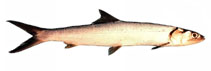
Spine dorsali (totale) : 0; Raggi dorsali molli (totale) : 23 - 27; Spine anali: 0; Raggi anali molli: 14 - 18. A gular plate present between arms of lower jaw. Branchiostegal rays numerous, approximately 20-25. All fins without spines. Scales very small, approximately 100 in lateral line.
Body shape (shape guide): elongated.
A coastal fish, commonly entering lagoon, bays, and estuaries (including fishponds) (Ref. 2847, 58302), particularly around mangroves (Ref. 44894). Sometimes enters freshwater streams, but does not penetrate very far inland (Ref. 2847). Benthopelagic (Ref. 58302). Younger fish often penetrate the lower freshwater reaches of rivers (Ref. 44894). An active swimmer, commonly traveling in schools in open water. Feeds on various fishes and crustaceans. Little detailed knowledge exists of its biology. Has a leptocephalus larva. Spawning takes place offshore and young larvae are found in the open sea, moving close to shore as they develop. Juveniles commonly found in salt marshes, canals, and tidal streams. Marketed fresh or frozen; in some places ground up as fish meal. A good sport fish on light tackle, striking a variety of artificial lures as well as live shrimp or baitfish. No separate statistics available. (Ref. 10983).
Ciclo vitale e comportamento di accoppiamento
Maturità | Riproduzione | Deposizione | Uova | Fecondità | Larve
Smith, D.G., 1997. Elopidae. Ladyfishes, tenpounders. p. 1619-1620. In K.E. Carpenter and V.H. Niem (eds.) FAO species identification guide for fishery purposes. The living marine resources of the WCP. Vol. 3. Batoid fishes, chimaeras and bony fishes part 1 (Elopidae to Linophrynidae). FAO, Rome. (Ref. 10983)
Stato della Lista Rossa IUCN (Ref. 130435: Version 2025-2 (Global))
Usi umani
Pesca: commerciale; Pesce da pesca sportiva: si
Strumenti
Rapporti speciali
Scarica XML
Fonti Internet
Stime basate su modelli
Temperatura preferita (Fonte Biblio.
123201): 24.5 - 29.3, mean 28.6 °C (based on 2710 cells).
Indice di diversità filogenetica (Fonte Biblio.
82804): PD
50 = 0.5176 [Uniqueness, from 0.5 = low to 2.0 = high].
Bayesian length-weight: a=0.00617 (0.00269 - 0.01415), b=2.99 (2.80 - 3.18), in cm total length, based on LWR estimates for this (Sub)family-body shape (Ref.
93245).
Livello trofico (Fonte Biblio.
69278): 4.0 ±0.62 se; based on food items.
Vulnerabilità della pesca (Ref.
59153): Very high vulnerability (88 of 100).
🛈
Nutrienti (Ref.
124155): Calcium = 77.5 [47.6, 137.7] mg/100g; Iron = 1.11 [0.70, 1.81] mg/100g; Protein = 16.8 [14.3, 19.8] %; Omega3 = 0.162 [0.090, 0.301] g/100g; Selenium = 50.9 [26.7, 100.8] μg/100g; VitaminA = 18.3 [7.4, 44.7] μg/100g; Zinc = 0.994 [0.727, 1.368] mg/100g (wet weight);