Elasmobranchii (tubarões e raias) (sharks and rays) >
Carcharhiniformes (Ground sharks) >
Triakidae (Houndsharks) > Triakinae
Etymology: Mustelus: Latin for weasel, an ancient name for sharks, possibly referring to the pointed snouts, swift movements and/or rapacious feeding behavior of smaller predatory sharks [strictly not tautonymous with Squalus mustelus Linnaeus 1758 since type was designated by the ICZN] (See ETYFish); stevensi: In honor of John Stevens (b. 1947), Senior Principal Research Scientist, CSIRO Marine and Atmospheric Research (Australia), who has “dedicated a lifetime to researching sharks around the world, and who has contributed greatly to our knowledge of sharks and rays in Australia” (See ETYFish).
Eponymy: Dr John Donald Stevens (d: 1947) is a biologist and ichthyologist who was a Senior Principal Research Scientist with CSIRO Marine and Atmospheric Research, originally in Sydney (1979–1984) and subsequently in Hobart, Tasmania, Australia (1984–2011). [...] (Ref. 128868), visit book page.
More on authors: White & Last.
Ambiente: milieu / zona climática / intervalo de profundidade / gama de distribuição
Ecologia
marinhas bentopelágico; intervalo de profundidade 69 - 735 m (Ref. 124465). Tropical
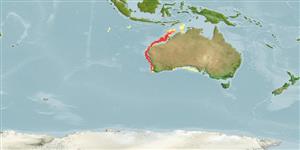
Eastern Indian Ocean: tropical, from northwest Australia to southern Indonesia and the Andaman Sea.
Comprimento na primeira maturidade / Tamanho / Peso / Idade
Maturidade: Lm 75.1, range 58 - 91.9 cm
Max length : 128 cm TL macho/indeterminado; (Ref. 124465); 103.4 cm TL (female)
Descrição breve
Chaves de identificação | Morfologia | Morfometria
This moderately large species is disinguished by the following characters: palatine processes of the
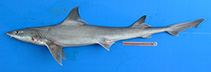
palatoquadrates not subdivided at the symphysis; pre-second dorsal length 58.1-61.4% TL; upper labial furrows are longer than lower furrows, upper ones 1.7-2.3% TL and 1.3-1.7 times lowers; buccopharyngeal denticles cover entire tongue and roof of mouth; reproductive mode aplacental viviparity; adults are without any hypercalcification of skeletal elements; dorsal fins moderately large and upright, first dorsal-fin anterior margin 13.0-15.7% TL, height 8.5-10.3% TL; claspers of adults are moderately long, inner length 8.1-11.2% TL; teeth in about 72/75 files; precaudal vertebral centra 75-91, monospondylous centra 33-41; small white spots usually present on the dorsal surfaces of body, including along lateral line; dorsal fins often with dark apical margins; caudal-fin terminal lobe white tipped (Ref. 124465).
Body shape (shape guide): elongated; Cross section: oval.
Recorded litter size litter sizes of 5-17 pups with size at birth likely to be around 28.0 cm TL (Ref. 124465).
Ciclo de vida e comportamento de acasalamento
Maturidade | Reprodução | Desova | Ovos | Fecundidade | Larvas
White, W.T., S. Arunrugstichai and G.J.P. Naylor, 2021. Revision of the genus Mustelus (Carcharhiniformes: Triakidae) in the northern Indian Ocean, with description of a new species and a discussion on the validity of M. walkeri and M. ravidus. Mar. Biodiversity 51(42):1-24. (Ref. 124465)
Categoria na Lista Vermelha da IUCN (Ref. 130435: Version 2025-2 (Global))
Ameaça para o homem
Harmless
Utilização humana
Ferramentas
Relatórios especiais
Descarregue XML
Fontes da internet
Estimativas baseadas em modelos
Temperatura preferida (Ref.
123201): 13.5 - 20.4, mean 16.5 °C (based on 27 cells).
Índice de diversidade filogenética (Ref.
82804): PD
50 = 0.5000 [Uniqueness, from 0.5 = low to 2.0 = high].
Bayesian length-weight: a=0.00229 (0.00107 - 0.00491), b=3.14 (2.97 - 3.31), in cm total length, based on LWR estimates for this Genus-body shape (Ref.
93245).
Nível Trófico (Ref.
69278): 3.7 ±0.4 se; based on size and trophs of closest relatives
Resiliência (Ref.
120179): Baixo, tempo mínimo de duplicação da população 4,5 - 14 anos (Preliminary K or Fecundity.).
Vulnerabilidade da pesca (Ref.
59153): Very high vulnerability (77 of 100).
🛈