>
Siluriformes (Catfishes) >
Pimelodidae (Long-whiskered catfishes)
Etymology: Pseudoplatystoma: Greek, pseudes = false + Greek, platys = flat + Greek, stoma = mouth (Ref. 45335).
More on author: Linnaeus.
Taxonomic Remarks
Considered as species inquirenda by some authors. Junior synonym Platystoma punctifer (Buitrago-Suárez, 2006:120) is considered valid by Buitrago-Suárez & Burr, 2007 (Ref. 59362). This species record will be modified.
Milieu: milieu / Klimaatzone / Diepte / verspreidingsgebied
Ecologie
; zoet water demersaal; pH range: 6.0 - 8.0; dH range: 4 - 30; potamodroom (Ref. 138143); diepte 5 - ? m. Tropical; 24°C - 28°C (Ref. 1672); 8°N - 11°S
South America: Amazon, Corantijn, Essequibo, Orinoco and Paraná River basins.
Lengte bij maturiteit / Grootte / Gewicht / Leeftijd
Maturiteit: Lm ?, range 53 - ? cm
Max length : 105 cm SL mannelijk / geslacht onbekend; (Ref. 111728); max. gepubliceerd gewicht: 70.0 kg (Ref. 35381)
Korte beschrijving
Determinatiesleutels | Morfologie | Morfometrie
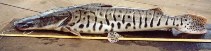
Adults occur throughout the principal riverbeds and sometimes in the flooded areas of forests. Their biology is similar to that of P. tigrinum but appear to be more fond of shady streams. They feed at night on fish (loricariids, cichlids and characoids) as well as crabs (Ref. 6868). Foraging activities are comfined to riverbeds. The yellowish flesh is succulent and like that of other silurids, it is without bones (Ref. 27188). Females reach a more notable size. They become sexually mature at 56 cm, males at 45 cm. Fecundity is estimated at 8 million eggs per kg (Ref. 35381). Utilized for human consumption. See Loubens and Panfili, 2000 (Ref. 34213) for reproductive biology and ecology.
Levenscyclus en paargedrag
Maturiteit | Voortplanting | Paaien | Eieren | Fecunditeit | Larven
Lundberg, J.G. and M.W. Littmann, 2003. Pimelodidae (Long-whiskered catfishes). p. 432-446. In R.E. Reis, S.O. Kullander and C.J. Ferraris, Jr. (eds.) Checklist of the Freshwater Fishes of South and Central America. Porto Alegre: EDIPUCRS, Brasil. (Ref. 36506)
Status op de Rode Lijst van het IUCN (Ref. 130435: Version 2025-2 (Global))
Gevaar voor de mens
Harmless
Gebruik door de mens
Visserij: commercieel; sportvis: ja; Aquarium: Publieke aquaria
Tools
Speciale rapporten
Download XML
Internetbronnen
Schattingen op basis van modellen
Fylogenetische diversiteitsindex (Ref.
82804): PD
50 = 0.5039 [Uniqueness, from 0.5 = low to 2.0 = high].
Bayesian length-weight: a=0.00794 (0.00506 - 0.01247), b=3.06 (2.93 - 3.19), in cm total length, based on LWR estimates for this species & (Sub)family-body (Ref.
93245).
Trofisch niveau (Ref.
69278): 4.4 ±0.78 se; based on food items.
Weerstandsvermogen (Ref.
120179): Gemiddeld, minimale populatieverdubbelingstijd 1,4-4,4 jaar (K=0.31-0.47; tm=3-5; Tmax=8.7).
Kwetsbaarheid van de visserij (Ref.
59153): Moderate vulnerability (43 of 100).
🛈
Voedingsstoffen (Ref.
124155): Calcium = 33.1 [16.2, 135.9] mg/100g; Iron = 2.28 [0.77, 5.23] mg/100g; Protein = 19.2 [17.6, 20.6] %; Omega3 = 0.443 [0.172, 1.148] g/100g; Selenium = 85.6 [34.3, 188.9] μg/100g; VitaminA = 33.3 [10.0, 109.6] μg/100g; Zinc = 0.937 [0.615, 1.398] mg/100g (wet weight); based on
nutrient studies.