Classification / Noms
Noms communs | Synonymes | Catalog of Fishes(Genre, Espèce) | ITIS | CoL | WoRMS | Cloffa
>
Gobiiformes (Gobies) >
Eleotridae (Bully sleepers)
Etymology: Hypseleotris: Greek, hypselos = high + The name of a Nile fish, eleotris (Ref. 45335); barrawayi: Named after the late Sandy Barraway, traditional owner of the Sleisbeck country, who had great knowledge of the fauna and stories associated with that country.
Eponymy: Sandy Barraway was, according to the etymology: “…the ‘traditional’ (i.e. aboriginal) owner of the Sleisbeck country (land or region), who had great knowledge of the fauna and stories associated with that country.” (Ref. 128868), visit book page.
More on author: Larson.
Environnement : milieu / zone climatique / profondeur / gamme de distribution
Écologie
; eau douce démersal; pH range: 7.3 - ? ; dH range: 11.48 - ?. Tropical
Oceania: known only from upper reaches of Katherine River system in Northern Territory, Australia.
Taille / Poids / Âge
Maturité: Lm ? range ? - ? cm
Max length : 5.8 cm SL mâle / non sexé; (Ref. 76845)
Description synthétique
Clés d'identification | Morphologie | Morphométrie
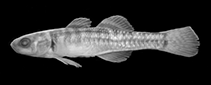
Épines dorsales (Total) : 6 - 8; Rayons mous dorsaux (Total) : 9 - 11; Épines anales: 1; Rayons mous anaux: 9 - 11; Vertèbres: 26 - 27. Distinguished from all other species of the genus Hypseleotris by a combination of the following characters: side of the body with distinct dark vertical bars; first and second dorsal fins banded with light and dark pigment; caudal fin plain or with several dusky bars or rows of spots; dark bar on pectoral base darkest dorsally and diffuse on ventral part of fin base; 26 vertebrae; preopercle with scales; postdorsal scale count usually 9, lateral scale count 30-34, usually 32, and predorsal scales scattered along midline of nape and/or above opercle and preopercle, not reaching eyes and often absent altogether (Ref. 76845).
Body shape (shape guide): fusiform / normal.
Prefers clear quiet water with sheltered places such as near steep banks with overhanging vegetation, among bankside roots, submerged logs. Reported to form large loose schools or occur in low abundance and solitary Ref. 76845).
Cycle de vie et comportement reproducteur
Maturité | Reproduction | Frai | Œufs | Fécondité | Larves
Larson, H.K., 2007. A new species of carp gudgeon, Hypseleotris (Pisces: Gobioidei: Eleotridae), from the Katherine River system, Northern Territory. The Beagle, Records of the Museums and Art Galleries of the Northern Territory 23:111-117. (Ref. 76845)
Statut dans la liste rouge de l'IUCN (Ref. 130435: Version 2025-2 (Global))
Menace pour l'homme
Harmless
Utilisations par l'homme
Outils
Articles particuliers
Télécharger en XML
Sources Internet
Estimations basées sur des modèles
Indice de diversité phylogénétique (Réf.
82804): PD
50 = 0.5000 [Uniqueness, from 0.5 = low to 2.0 = high].
Bayesian length-weight: a=0.00977 (0.00411 - 0.02324), b=3.08 (2.88 - 3.28), in cm total length, based on LWR estimates for this (Sub)family-body shape (Ref.
93245).
Niveau trophique (Réf.
69278): 3.2 ±0.2 se; based on size and trophs of closest relatives
Résilience (Réf.
120179): Haut, temps minimum de doublement de population inférieur à 15 mois (Preliminary K or Fecundity.).
Vulnérabilité de la pêche (Ref.
59153): Low vulnerability (10 of 100).
🛈