Clasificación / Nombres
Nombres comunes | Sinónimos | Catalog of Fishes(Género, Especie) | ITIS | CoL | WoRMS | Cloffa
>
Siluriformes (Catfishes) >
Mochokidae (Squeakers or upside-down catfishes) > Mochokinae
Etymology: Synodontis: Greek, syn, symphysis = grown together + Greek, odous = teeth (Ref. 45335); macropunctatus: The specific epiteth is a combination of the Greek 'makros', meaning large, and the Latin 'punctata', meaning spotted, a reference to the large spots that characterize the coloration pattern of this species (Ref. 75786).
Entorno: milieu / zona climática / rango de profundidad / gama de distribución
Ecología
; agua dulce demersal. Tropical
Africa: Uamba River (Kwango drainage) and southern tributaries of the Kasai (middle Congo River basin) in Angola (Ref. 11970, 75786).
Tamaño / Peso / Edad
Madurez: Lm ? range ? - ? cm
Max length : 22.9 cm SL macho / no sexado; (Ref. 75786)
Descripción breve
Claves de identificación | Morfología | Morfometría
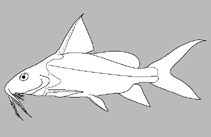
Espinas dorsales (total) : 2; Radios blandos dorsales (total) : 7; Espinas anales: 4 - 5; Radios blandos anales: 8 - 9. Length of the maxillary barbel 37.2-48.5% of standard length and 138.2-176.3% of head length; length of lateral mandibular barbel 87.2-107.9% of head length; length of medial mandibular barbel 38.5-54.5% of head length (Ref. 75786). Number of mandibular teeth 27-35 (Ref. 75786). Humeral process triangular, granulous; possessing poorly developed ridge on ventral margin; dorsal margin concave to slightly convex in largest specimens, with 0-2 small, pointed projections; terminating in sharp point (Ref. 75786).
Colour: In preservation, dorsum pale to dark brown, covered with large dark spots; ventral areas light with dark spots; maxillary and mandibular barbels light brown; Dorsal en pectoral-fin spines brownish, filaments dark; all fins light brown with large dark spots (Ref. 75786).
Body shape (shape guide): fusiform / normal.
Prefers deeper water near river banks (Ref. 11970). Nothing is known about the diet, reproductive behavior, or abundance of this species (Ref. 75786).
Ciclo vital y comportamiento de apareamiento
Madurez | Reproducción | Puesta | Huevos | Fecundidad | Larva
Wright, J.J. and L.M. Page, 2008. A new species of Synodontis (Siluriformes: Mochokidae) from tributaries of the Kasai River in Northern Angola. Copeia 2008(2):294-300. (Ref. 75786)
Situación en la Lista Roja de la UICN (Ref. 130435: Version 2025-2 (Global))
Amenaza para el ser humano
Harmless
Usos humanos
Herramientas
Informes especiales
Descargar XML
Fuentes de Internet
Estimaciones basadas en modelos
Índice de diversidad filogenética (Referencia
82804): PD
50 = 0.5000 [Uniqueness, from 0.5 = low to 2.0 = high].
Bayesian length-weight: a=0.01445 (0.00659 - 0.03170), b=2.90 (2.72 - 3.08), in cm total length, based on LWR estimates for this Genus-body shape (Ref.
93245).
Nivel trófico (Referencia
69278): 2.9 ±0.3 se; based on size and trophs of closest relatives
Resiliencia (Referencia
120179): Alto, población duplicada en un tiempo mínimo inferior a 15 meses (Preliminary K or Fecundity.).
Vulnerabilidad pesquera (Ref.
59153): Low vulnerability (18 of 100).
🛈