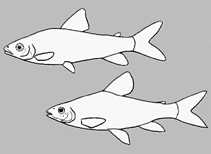
>
Characiformes (Characins) >
Anostomidae (Headstanders)
Etymology: Schizodon: Greek, schizein = to divide + Greek, odous = teeth (Ref. 45335); scotorhabdotus: Specific name derived from the Greek scotos (dark), and rhabdos (rod or stick), in reference to the prominent dark lateral stripe of this species,.
Môi trường: môi trường / vùng khí hậu / Mức độ sâu / phạm vi phân phối
Sinh thái học
; nước ngọt sống nổi và đáy. Tropical
South America: Río Orinoco system in Venezuela and Colombia.
Chiều dài lúc trưởng thành đầu tiên / Bộ gần gũi / Khối lượng (Trọng lượng) / Tuổi
Chín muồi sinh dục: Lm ?, range 28 - ? cm
Max length : 27.1 cm SL con đực/không giới tính; (Ref. 75767)
Mô tả ngắn gọn
Khóa để định loại | Hình thái học | Sinh trắc học
Các vây lưng mềm (tổng cộng) : 11 - 12; Tia mềm vây hậu môn: 9; Động vật có xương sống: 40 - 42. Can be separated from all congeners, except Schizodon isognathus, Schizodon knerii, and Schizodon nasutus, by the presence of a dark stripe running along the lateral-line-scale row from the rear of the opercle to the caudal peduncle (vs. absence of midlateral stripe in Schizodon altoparanae, Schizodon australis, Schizodon borelli, Schizodon corti, Schizodon dissimilis, Schizodon fasciatus, Schizodon intermedius, Schizodon platae, and Schizodon rostratus), and midlateral stripe extending no further anteriorly than to vertical drawn through dorsal-fin origin in Schizodon jacuiensis and Schizodon vittatus). Differs from Schizodon nasutus by a terminal or slightly upturned mouth (vs. a strongly subterminal mouth). Can be differentiated from Schizodon isognathus and Schizodon knerii by having 4 or 4.5 transverse scale rows above the lateral line to the dorsal-fin origin (vs. 6.5 scale rows [rarely 5.5 in Schizodon knerii]), 4 or 4.5 transverse scale rows below the lateral line to the anal-fin origin (vs. 5.5 scale rows [rarely 4.5 in Schizodon knerii]) and seven branched anal-fin rays (vs. eight). Differs further from Schizodon isognathus by the presence of three or four vertical dark blotches on the lateral surfaces of the body intersecting the prominent lateral stripe (vs. vertical blotches absent) and a terminal mouth in adults (vs. a slightly subterminal mouth in adults); and Schizodon knerii by having only 16 circumpeduncular scales (vs. 18-20) (Ref. 75767).
Found in lagoons, pools, small caños and cattle pastures, all relatively lentic habitats (Ref. 75767). Herbivorous, preferring macrophytes (Ref. 75767). Distinct pairs breed on densely grown weedy places (Ref. 205).
Distinct pairs breed on densely grown weedy places (Ref. 205).
Sidlauskas, B.L., J.C. Garavello and J. Jellen, 2007. A new Schizodon (Characiformes: Anostomidae) from the Río Orinoco system, with a redescription of S. isognathus from the Río Paraguay System. Copeia 2007(3):711-725. (Ref. 75767)
Tình trạng Sách đỏ IUCN (Ref. 130435: Version 2025-2 (Global))
Mối đe dọa đối với con người
Harmless
Sử dụng của con người
Các công cụ
Báo cáo đặc biệt
Tải xuống XML
Các nguồn internet
Ước tính dựa trên mô hình
Chỉ số đa dạng phát sinh loài (Tài liệu tham khảo
82804): PD
50 = 0.5000 [Uniqueness, from 0.5 = low to 2.0 = high].
Bayesian length-weight: a=0.00776 (0.00349 - 0.01726), b=3.06 (2.88 - 3.24), in cm total length, based on LWR estimates for this Genus-body shape (Ref.
93245).
Mức dinh dưỡng (Tài liệu tham khảo
69278): 2.5 ±0.2 se; based on size and trophs of closest relatives
Thích nghi nhanh (Tài liệu tham khảo
120179): Trung bình, thời gian nhân đôi của chủng quần tối thiểu là 1.4 - 4.4 năm (Preliminary K or Fecundity.).
Sự dễ bị tổn thương của nghề đánh cá (Ref.
59153): Low vulnerability (23 of 100).
🛈