Classificazione / Nomi
Nomi Comuni | Sinonimi | Catalog of Fishes(Genere, Specie) | ITIS | CoL | WoRMS | Cloffa
>
Siluriformes (Catfishes) >
Loricariidae (Armored catfishes) > Hypoptopomatinae
Etymology: Otocinclus: Greek, ous, oto = ear + Latin, cinclus = latticework; in allusion to the holes of the head in the ears (Ref. 45335); batmani: The specific name batmani is an allusion to the Bob Kane's hero Batman of the comic adventures, which had a bat shape for his symbol, referring to the single W- or bat-shaped vertical spot on the caudal fin.
Eponymy: Batman, who has a bat shape for a symbol, is a comic book super-hero who first appeared in Detective Comics (1939). The etymology refers to the single W or bat-shaped vertical spot on the caudal fin of this species. (Ref. 128868), visit book page.
Ambiente: milieu / zona climatica / distribuzione batimetrica / gamma di distribuzione
Ecologia
; acqua dolce demersale. Tropical
South America: small stream tributary to the Río Puré in Colombia, and two creeks emptying into the Río Amazonas near Iquitos, Peru, in the upper Amazin River basin.
Dimensione / Peso / Età
Maturità: Lm ? range ? - ? cm
Max length : 3.7 cm SL maschio/sesso non determinato; (Ref. 75892)
Breve descrizione
Chiavi di identificazione | Morfologia | Morfometria
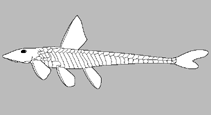
Spine dorsali (totale) : 2; Raggi dorsali molli (totale) : 7 - 8; Raggi anali molli: 6; Vertebre: 22. Distinguished from all other congeners, except Otocinclus cocama, by having a single,
intensely pigmented, vertical W-shaped caudal fin spot and by having three discrete dark bands on dorsum, between the dorsal-fin base and the caudal fin. Can be separated from Otocinclus cocama by the absence of vertically elongated blotches from the dorsal midline to the ventral border of flanks, and by lacking the posterior extension of black
pigmentation on the base of two central caudal-fin rays. Differs from most Otocinclus
species, except Otocinclus bororo, Otocinclus cocama, Otocinclus mariae, Otocinclus mura, and Otocinclus huaorani, by possessing 20 or more teeth in both the premaxilla and dentary (vs. less that 20 in all other species) (Ref. 75892).
Body shape (shape guide): elongated.
Facultative air-breathing in the genus (Ref. 126274)
Ciclo vitale e comportamento di accoppiamento
Maturità | Riproduzione | Deposizione | Uova | Fecondità | Larve
Lehmann A.P., 2006. Otocinclus batmani, a new species of hypoptopomatine catfish (Siluriformes: Loricariidae) from Colombia and Peru. Neotrop. Ichthyol. 4(4):379-383. (Ref. 75892)
Stato della Lista Rossa IUCN (Ref. 130435: Version 2025-2 (Global))
Minaccia per l'uomo
Harmless
Usi umani
Strumenti
Rapporti speciali
Scarica XML
Fonti Internet
Stime basate su modelli
Indice di diversità filogenetica (Fonte Biblio.
82804): PD
50 = 0.5000 [Uniqueness, from 0.5 = low to 2.0 = high].
Bayesian length-weight: a=0.00977 (0.00434 - 0.02202), b=3.06 (2.87 - 3.25), in cm total length, based on LWR estimates for this (Sub)family-body shape (Ref.
93245).
Vulnerabilità della pesca (Ref.
59153): Low vulnerability (10 of 100).
🛈