Classificazione / Nomi
Nomi Comuni | Sinonimi | Catalog of Fishes(Genere, Specie) | ITIS | CoL | WoRMS | Cloffa
>
Characiformes (Characins) >
Characidae (Characins; tetras) > Characinae
Etymology: Acestrocephalus: Greek, agkistron = hook + Greek, kepahle = head (Ref. 45335); acutus: From the Latin adjective acutus, meaning sharp, in reference to the pointed nature of the snout of this species.
Ambiente: milieu / zona climatica / distribuzione batimetrica / gamma di distribuzione
Ecologia
; acqua dolce benthopelagico. Tropical
South America: Rio Tocantins and rio Tapajós drainages in Brazil.
Dimensione / Peso / Età
Maturità: Lm ? range ? - ? cm
Max length : 10.4 cm SL maschio/sesso non determinato; (Ref. 75890)
Breve descrizione
Chiavi di identificazione | Morfologia | Morfometria
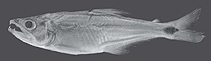
Raggi dorsali molli (totale) : 11; Raggi anali molli: 33 - 39; Vertebre: 37 - 39. Among the species of Acestrocephalus with dark humeral blotch absent, this species can be separated from Acestrocephalus sardina and Acestrocephalus nigrifasciatus by possessing a smaller eye (28.0- 31.7 vs. 32.6-36.5 in Acestrocephalus nigrifasciatus and 31.3-37.4 in Acestrocephalus sardina); and an oblong dark blotch at caudal base instead of the triangular dark blotch present on the caudal base of those two species. Distinguished from Acestrocephalus pallidus by having an oblong dark blotch at caudal base (vs. absence of dark blotch); and differs further from Acestrocephalus pallidus by the shape of the muscular hiatus of the pseudotympanum and the muscular arrangement around it. Can be diagnosed from Acestrocephalus anomalus by having more teeth in the posterior row on dentary (28-36 vs. 23-28) and fewer teeth in the external tooth row on premaxilla (6-8 vs. 8-11) (Ref. 75890).
Body shape (shape guide): fusiform / normal.
Ciclo vitale e comportamento di accoppiamento
Maturità | Riproduzione | Deposizione | Uova | Fecondità | Larve
Menezes, N.A., 2006. Description of five new species of Acestrocephalus Eigenmann and redescription of A. sardina and A. boehlkei (Characiformes: Characidae). Neotrop. Ichthyol. 4(4):385-400. (Ref. 75890)
Stato della Lista Rossa IUCN (Ref. 130435: Version 2025-2 (Global))
Minaccia per l'uomo
Harmless
Usi umani
Strumenti
Rapporti speciali
Scarica XML
Fonti Internet
Stime basate su modelli
Indice di diversità filogenetica (Fonte Biblio.
82804): PD
50 = 0.5039 [Uniqueness, from 0.5 = low to 2.0 = high].
Bayesian length-weight: a=0.01000 (0.00444 - 0.02253), b=3.09 (2.89 - 3.29), in cm total length, based on LWR estimates for this (Sub)family-body shape (Ref.
93245).
Livello trofico (Fonte Biblio.
69278): 3.7 ±0.6 se; based on size and trophs of closest relatives
Vulnerabilità della pesca (Ref.
59153): Low vulnerability (10 of 100).
🛈