>
Gobiiformes (Gobies) >
Gobiidae (Gobies) > Gobiinae
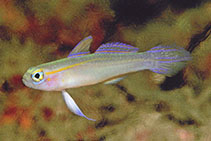
Etymology: Tryssogobius: Greek, tryo, tryso = to wear away + see under Gobius; flavolineatus: Name from Latin 'flavus' for yellow and 'lineatus' for line, refers to the most conspicuous colour marking, the yellow line passing from behind the eye to below the first dorsal fin.
More on author: Randall.
Environnement : milieu / zone climatique / profondeur / gamme de distribution
Écologie
marin démersal; profondeur 28 - 82 m (Ref. 75950). Tropical
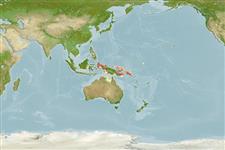
Western Pacific: New Guinea and Indonesia.
Taille / Poids / Âge
Maturité: Lm ? range ? - ? cm
Max length : 2.5 cm SL (female)
Description synthétique
Clés d'identification | Morphologie | Morphométrie
Épines dorsales (Total) : 7; Rayons mous dorsaux (Total) : 10; Épines anales: 1; Rayons mous anaux: 11; Vertèbres: 26. This species is distinguished by the following characters: D VI + I, 10; A I, 11; pectoral rays 17-19; cheek with 2 rows of scales; eye diameter 2.45-2.7 in HL; interorbital width 4.6-5.65 in HL; first dorsal spine longest in adults, 3.65-4.65 in SL, but second and third spines are nearly as long; rhomboid caudal fin, 2.6-3.5 in SL; pectoral fins 3.4-3.6 in SL; grey with a dark-edged yellow line from behind eye, parallel to dorsal profile of postorbital head and nape, and ending below first dorsal fin; base of dorsal fins with a narrow yellow band; caudal fin with 3 blue-edged yellow stripes; pelvic fins whitish (Ref. 75950).
Body shape (shape guide): fusiform / normal; Cross section: oval.
Inhabits sheltered reefs with silty sand and rubble bottoms in 25-82 m (Ref. 90102).
Cycle de vie et comportement reproducteur
Maturité | Reproduction | Frai | Œufs | Fécondité | Larves
Randall, J.E., 2006. Three new species of the gobiid fish genus Tryssogobius from the western and South Pacific. Aqua, 11(3):105-116. (Ref. 75950)
Statut dans la liste rouge de l'IUCN (Ref. 130435: Version 2025-2 (Global))
Menace pour l'homme
Harmless
Utilisations par l'homme
Outils
Articles particuliers
Télécharger en XML
Sources Internet
Estimations basées sur des modèles
Température préférée (Réf.
123201): 27 - 28.8, mean 27.7 °C (based on 24 cells).
Indice de diversité phylogénétique (Réf.
82804): PD
50 = 0.5078 [Uniqueness, from 0.5 = low to 2.0 = high].
Bayesian length-weight: a=0.01023 (0.00477 - 0.02194), b=3.01 (2.83 - 3.19), in cm total length, based on LWR estimates for this (Sub)family-body shape (Ref.
93245).
Niveau trophique (Réf.
69278): 3.1 ±0.3 se; based on size and trophs of closest relatives
Résilience (Réf.
120179): Haut, temps minimum de doublement de population inférieur à 15 mois (Preliminary K or Fecundity.).
Vulnérabilité de la pêche (Ref.
59153): Low vulnerability (10 of 100).
🛈