>
Perciformes/Uranoscopoidei (Sand dwellers) >
Pinguipedidae (Sandperches)
Etymology: Parapercis: Greek, para = the side of + Greek, perke = perch (Ref. 45335); phenax: Name from a Greek word meaning imposter, refers to its resemblance to, and previous misidentification as, P. roseoviridis.
More on authors: Randall & Yamakawa.
Entorno: milieu / zona climática / rango de profundidad / gama de distribución
Ecología
marino batidemersal; rango de profundidad 322 - 600 m (Ref. 75889). Temperate
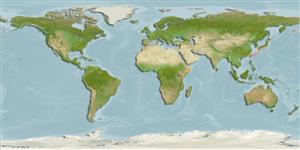
Northwest Pacific: Japan.
Tamaño / Peso / Edad
Madurez: Lm ? range ? - ? cm
Max length : 18.0 cm SL macho / no sexado; (Ref. 75889); 14.7 cm SL (female)
Descripción breve
Claves de identificación | Morfología | Morfometría
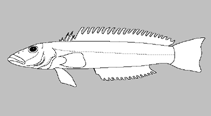
Espinas dorsales (total) : 4 - 5; Radios blandos dorsales (total) : 23 - 24; Espinas anales: 1; Radios blandos anales: 19 - 20; Vértebra: 31 - 33. This species is distinguished by the following characters: D IV-V (rarely IV); A I, 19-20 (usually 19); pectoral rays 19-20 (usually 19); lateral-line scales 60-64; gill rakers 4-7 + 10-13; canine teeth 3 pairs, anteriorly in lower jaw; palatine teeth present; body depth 5.0-5.95 in SL; head length 3.45-3.6 in SL; last 2 dorsal spines subequal, the last usually the longest, 3.8-4.15 in HL; last interspinous membrane of dorsal fin attached to the first dorsal soft ray nearly 1/2 length of ray from its base; caudal fin slightly rounded; pelvic fins reaching or extending slightly beyond anus, 1.25-1.55 in HL; body pink dorsally, lavender-white ventrally, with a series of 10 short dusky green to yellow bars on upper side of body (indistinct dorsally), the last 2 on caudal peduncle nearly merged; spinous portion of dorsal fin largely black in color (Ref. 75889).
Body shape (shape guide): elongated.
Ciclo vital y comportamiento de apareamiento
Madurez | Reproducción | Puesta | Huevos | Fecundidad | Larva
Randall, J.E. and T. Yamakawa, 2006. Parapercis phenax from Japan and P. banoni from the Southeast Atlantic, new species of Pinguipedid fishes previously identified as P. roseoviridis. Zool. Stud. 45(1):1-10. (Ref. 75889)
Situación en la Lista Roja de la UICN (Ref. 130435: Version 2025-2 (Global))
Amenaza para el ser humano
Harmless
Usos humanos
Herramientas
Informes especiales
Descargar XML
Fuentes de Internet
Estimaciones basadas en modelos
Temperatura preferida (Referencia
123201): 10.4 - 14.7, mean 12.7 °C (based on 61 cells).
Índice de diversidad filogenética (Referencia
82804): PD
50 = 0.5000 [Uniqueness, from 0.5 = low to 2.0 = high].
Bayesian length-weight: a=0.00692 (0.00314 - 0.01524), b=3.06 (2.88 - 3.24), in cm total length, based on LWR estimates for this Genus-body shape (Ref.
93245).
Nivel trófico (Referencia
69278): 3.6 ±0.4 se; based on size and trophs of closest relatives
Resiliencia (Referencia
120179): Alto, población duplicada en un tiempo mínimo inferior a 15 meses (Preliminary K or Fecundity.).
Vulnerabilidad pesquera (Ref.
59153): Low vulnerability (12 of 100).
🛈