Classificatie / Namen
Lokale namen | Synoniemen | Catalog of Fishes(Genus, Soort(en)) | ITIS | CoL | WoRMS | Cloffa
>
Siluriformes (Catfishes) >
Sisoridae (Sisorid catfishes) > Glyptosterninae
Etymology: Pareuchiloglanis: Greek, para = near + Greek, cheilo = lip + Greek, glanis = a fish that can eat the bait without touching the hook; a cat fish (Ref. 45335); prolixdorsalis: Derived from the Latin prolixus (extended), and dorsalis (dorsal), in reference to the longer distance from the end of the dorsal-fin base to the origin of the adipose fin, distinguished from Pareuchiloglanis abbreviatus.
Milieu: milieu / Klimaatzone / Diepte / verspreidingsgebied
Ecologie
; zoet water demersaal. Tropical
Asia: Lancangjiang [Mekong] drainage in China.
Grootte / Gewicht / Leeftijd
Maturiteit: Lm ? range ? - ? cm
Max length : 14.8 cm SL mannelijk / geslacht onbekend; (Ref. 75856)
Korte beschrijving
Determinatiesleutels | Morfologie | Morfometrie
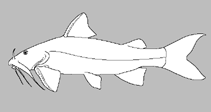
Dorsale zachte stralen (totaal) : 6 - 7; Anale zachte stralen: 6. Distinguished by the following unique combination of characters: adipose-fin base not confluent with caudal fin (vs. confluent); premaxillary tooth patches appear joined (vs. separate); lower lip connected to base of maxillary barbel by skin flap, without sulcus between them (vs. not connected, with sulcus); 6 upper + 7 lower branched caudal fin rays (vs. 7+8); dorsal fin i-5-6 (vs. i-7); anal fin ii-4 (vs. ii-8); distance between pelvic-fin origin to anal-fin origin longer than distance between pelvic-fin origin to mouth (vs. equal); pectoral fins not reaching origin of pelvic fin (vs. reaching); origin of pelvic fins opposite to end of dorsal-fin base (vs. posterior to end of dorsal fin base); anus nearer to posterior end of pelvic-fin base than to anal-fin origin (vs. nearer to anal-fin origin); long interdorsal, tip of dorsal fin not reaching origin of adipose fin when depressed (vs. reaching); caudal peduncle length 18.2–22.2% SL; caudal peduncle depth 4.5-5.6% SL (Ref. 75856).
Body shape (shape guide): elongated.
Levenscyclus en paargedrag
Maturiteit | Voortplanting | Paaien | Eieren | Fecunditeit | Larven
Li, X., W. Zhou, A.W. Thomson, Q. Zhang and Y. Yang, 2007. A review of the genus Pareuchiloglanis (Sisoridae) from the Lancangjiang (Upper Mekong River) with descriptions of two new species from Yunnan, China. Zootaxa 1440:1-19. (Ref. 75856)
Status op de Rode Lijst van het IUCN (Ref. 130435: Version 2025-2 (Global))
Gevaar voor de mens
Harmless
Gebruik door de mens
Tools
Speciale rapporten
Download XML
Internetbronnen
Schattingen op basis van modellen
Fylogenetische diversiteitsindex (Ref.
82804): PD
50 = 0.5000 [Uniqueness, from 0.5 = low to 2.0 = high].
Bayesian length-weight: a=0.00603 (0.00269 - 0.01352), b=3.08 (2.88 - 3.28), in cm total length, based on LWR estimates for this (Sub)family-body shape (Ref.
93245).
Trofisch niveau (Ref.
69278): 3.2 ±0.4 se; based on size and trophs of closest relatives
Weerstandsvermogen (Ref.
120179): Gemiddeld, minimale populatieverdubbelingstijd 1,4-4,4 jaar (Preliminary K or Fecundity.).
Kwetsbaarheid van de visserij (Ref.
59153): Low vulnerability (10 of 100).
🛈