Classificação / Nomes
Nomes comuns | Sinônimos | Catalog of Fishes(Gênero, Espécies) | ITIS | CoL | WoRMS | Cloffa
>
Siluriformes (Catfishes) >
Loricariidae (Armored catfishes) > Hypostominae
Etymology: Pterygoplichthys: Greek, pterygion, diminutive of pteryx = wing, fin + Greek, hoplon = weapon + Greek, ichthys = fish (Ref. 45335); weberi: Named after Claude Weber of the Muséum d'histoire naturelle , Geneva, for his fine work on Pterygoplichthys and his contributions to loricariid systematics.
Eponymy: Dr Claude Weber works at the Department of Herpetology and Ichthyology, Muséum d’Histoire Naturelle de Génève. [...] (Ref. 128868), visit book page.
Meio ambiente: milieu / Zona climática / intervalo de profundidade / faixa de distribuição
Ecologia
; Água doce demersal. Tropical
South America: Rio Marañon, Rio Ucayali, Rio Caquetá and upper Rio Amazonas drainages of Colombia, Ecuador and Peru.
Tamanho / Peso / Idade
Maturidade: Lm ? range ? - ? cm
Max length : 19.7 cm SL macho/indeterminado; (Ref. 75871)
Descrição suscinta
Chaves de identificação | Morfologia | Morfometria
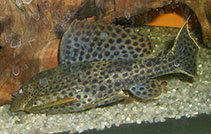
Espinhos dorsais (total) : 1; Raios dorsais (total) : 11 - 12; Espinhos anais: 1; Raios anais : 4. Distinguished from all congeners except Pterygoplichthys punctatus by having the buccal papilla at least shallowly divided medially; and by having the lateral keel odontodes almost perpendicular to the plates (vs. sloped posteriorly) and by having the longest keel odontodes longer than the plates in the lateral-line row in the adult. Differs further Pterygoplichthys punctatus by having the buccal papilla partially divided in the adult (vs. fully divided at all ages), by having few spots on the abdomen and the bases of the fins (vs. many spots), and by having a wider body (SL/cleithral width 3.3-3.4 vs. 3.6-4.0). Can be further distinguished from Pterygoplichthys scrophus, Pterygoplichthys gibbiceps, Pterygoplichthys joselimaianus, Pterygoplichthys xinguensis, Pterygoplichthys lituratus, and Pterygoplichthys parnaibae by the absence of an elevated supraoccipital (vs. presence of an elevated supraoccipital forming an obvious crest); from Pterygoplichthys etentaculatus by having fewer than five hypertrophied odontodes on the cheek plates (vs. more than five); from Pterygoplichthys joselimaianus by having dark spots (vs. light spots); from Pterygoplichthys undecimalis and Pterygoplichthys zuliaensis by having a broadly round snout (vs. a narrow pointed snout); from Pterygoplichthys multiradiatus by usually having 11 dorsal-fin rays (occasionally 12 vs. 12-13); and from Pterygoplichthys anisitsi,
Pterygoplichthys disjunctivus, Pterygoplichthys multiradiatus, and Pterygoplichthys pardalis by having hypertrophied odontodes on the cheek plates of the adult (vs. hypertrophied cheek odontodes absent) (Ref. 75871).
Body shape (shape guide): elongated.
Facultative air-breathing (Ref. 126274)
Ciclo de vida ou comportamento de acasalamento
Maturidade | Reprodução | Desova | Ovos | Fecundidade | Larvas
Armbruster, J.W. and L.M. Page, 2006. Redescription of Pterygoplichthys punctatus and description of a new species of Pterygoplichthys (Siluriformes: Loricariidae). Neotrop. Ichthyol. 4(4):401-409. (Ref. 75871)
Status na Lista Vermelha da UICN (Ref. 130435: Version 2025-2 (Global))
Ameaça para os humanos
Harmless
Uso pelos humanos
Ferramentas
Relatórios especiais
Baixar XML
Fontes da internet
Estimativas baseadas em modelos
Índice de diversidade filogenética (Ref.
82804): PD
50 = 0.5000 [Uniqueness, from 0.5 = low to 2.0 = high].
Bayesian length-weight: a=0.01995 (0.00870 - 0.04578), b=2.95 (2.78 - 3.12), in cm total length, based on LWR estimates for this Genus-body shape (Ref.
93245).
Resiliência (Ref.
120179): médio(a), tempo mínimo de duplicação da população 1,4 - 4,4 anos (Preliminary K or Fecundity.).
Vulnerabilidade da pesca (Ref.
59153): Low vulnerability (14 of 100).
🛈