Klassifizierung / Names
Namen | Synonyme | Catalog of Fishes(Gattung, Arten) | ITIS | CoL | WoRMS | Cloffa
>
Cyprinodontiformes (Rivulines, killifishes and live bearers) >
Rivulidae (Rivulines) > Cynolebiinae
Etymology: Leptolebias: Greek, leptos = thin + Greek,lebias, -ou = a kind of fish (Ref. 45335); itanhaensis: The specific name itanhaensis denotes the presence of this species in the Itanhaém river basin, an isolated small coastal drainage of southeastern Brazil.
More on author: Costa.
Umwelt: Milieu / Klimazone / Tiefenbereich / Verbreitungsgebiet
Ökologie
; süßwasser benthopelagisch; pH range: 3.5 - 4.0; tiefenbereich 0 - ? m (Ref. 75888). Tropical
South America: seasonal pools in the Itanhaém river basin in southeastern Brazil.
Größe / Gewicht / Alter
Geschlechtsreife: Lm ? range ? - ? cm
Max length : 2.2 cm SL Männchen/unbestimmt; (Ref. 75888)
Kurzbeschreibung
Bestimmungsschlüssel | Morphologie | Morphometrie
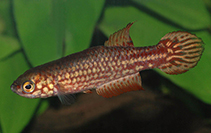
Rückenflossenweichstrahlen (insgesamt) : 13 - 16; Afterflossenweichstrahlen: 16 - 19. Diagnosed from other species of the genus Leptolebias except Leptolebias aureoguttatus by having four caudal neuromasts (vs. two), and horizontal golden lines on caudal fin in males (vs. no similar color pattern). Differs from Leptolebias aureoguttatus by possessing the following characters: two dark-red stripes on dorsal and ventral submarginal portion of caudal restricted to anterior portion of fin in males (vs. along all fin extension); male caudal-fin stripes parallel to fin rays, not branching posteriorly (vs. branching posteriorly); basal portion of dorsal fin with dark-orange small spots in males (vs. dark-red to dark-brown short transverse bars); and five or six lateral mandibular neuromasts (vs. three or four). Can also be differentiated from all congeners in the number of caudal fin rays, 27-31 vs. 25-28 (Ref. 75888).
Occurs in shallow (about 10-40 cm deep), temporary channels within dense rainforest, in tea-colored and acidic (pH 3.5-4.0) water with litter at the bottom (Ref. 75888).
Lebenszyklus und Paarungsverhalten
Geschlechtsreife | Fortpflanzung | Ablaichen | Eier | Fruchtbarkeit | Larven
Costa, W.J.E.M., 2008. Monophyly and taxonomy of the Neotropical seasonal killifish genus Leptolebias (Teleostei: Aplocheiloidei: Rivulidae), with the description of a new genus. Zool. J. Linn. Soc. 153:147-160. (Ref. 75888)
IUCN Rote Liste Status (Ref. 130435: Version 2025-2 (Global))
Bedrohung für Menschen
Harmless
Nutzung durch Menschen
Tools
Zusatzinformationen
Download XML
Internet Quellen
Schätzungen auf der Grundlage von Modellen
Phylogenetischer Diversitätsindex (Ref.
82804): PD
50 = 0.5156 [Uniqueness, from 0.5 = low to 2.0 = high].
Bayesian length-weight: a=0.00617 (0.00266 - 0.01427), b=3.13 (2.93 - 3.33), in cm total length, based on LWR estimates for this (Sub)family-body shape (Ref.
93245).
Trophische Ebene (Ref.
69278): 3.1 ±0.4 se; based on size and trophs of closest relatives
Widerstandsfähigkeit (Ref.
120179): hoch, Verdopplung der Population dauert weniger als 15 Monate. (Preliminary K or Fecundity.).
Anfälligkeit der Fischerei (Ref.
59153): Low vulnerability (10 of 100).
🛈