>
Siluriformes (Catfishes) >
Anchariidae (Vaonas)
Etymology: Gogo: Gogo is the Malagasy word most commonly used to refer to members of Anchariidae; atratus: The specific epithet comes from the Latin atratus, meaning clothed in black, in reference to the dark colouration of this species in preservative (Ref. 75790).
Milieu: milieu / Klimaatzone / Diepte / verspreidingsgebied
Ecologie
; zoet water demersaal. Tropical
Africa: Mananara du Nord River drainage in northeastern Madagascar (Ref. 75790).
Grootte / Gewicht / Leeftijd
Maturiteit: Lm ? range ? - ? cm
Max length : 17.1 cm SL mannelijk / geslacht onbekend; (Ref. 75790)
Korte beschrijving
Determinatiesleutels | Morfologie | Morfometrie
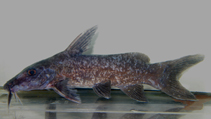
Dorsale stekels (totaal) : 2; Dorsale zachte stralen (totaal) : 7; Anale stekels: 0; Anale zachte stralen: 11 - 12; Wervels: 43 - 44. Diagnosis: Gogo atratus is distinguished from congeners in having a longer snout, 54.8-56.4% of head length vs. 47.1-54.3%; and faintly mottled dark gray colouration vs. uniform brown, highly mottled dark gray and cream, or mottled brownish-gray (Ref. 75790). It further differs from Gogo ornatus in having a larger eye in specimens larger than 110 mm standard length, eye diameter 13.0-14.3% of head length vs. 9.2-12.5% (Ref. 75790). It differs from G. brevibarbis in having unicuspid teeth vs. bicuspid, and a smaller eye, eye diameter 13.0-14.3% of head length vs. 19.5% (Ref. 75790). It differs from G. arcuatus in having a narrower head, head width 17.8-18.9% of standard length vs. 20.8-21.0% and interorbital distance 28.9-30.5% of head length vs. 34.8-35.1%; smaller eye, eye diameter 13.0-14.3% of head length vs. 17.7-18.6%; shorter dorsal spine, 17.7-20.6% of standard length vs. 21.2-21.8%; shorter pectoral spine, 16.5-18.9% of standard length vs. 19.9-20.2%; and a straight dorsoposterior margin of the dorsal fin vs. concave (Ref. 75790).
Found over an open sand/cobble bottom interspersed with scattered rocky ourcroppings at a depth of less than 1 m; the water is clear, with the bottom consisting of either sand or rock/cobble; the bottom is lightly overlain with leaf litter in quieter stretches of the river (Ref. 75790).
Levenscyclus en paargedrag
Maturiteit | Voortplanting | Paaien | Eieren | Fecunditeit | Larven
Ng, H.H., J.S. Sparks and P.V. Loiselle, 2008. A new species of catfish of the genus Gogo from the Northeastern Madagascar (Siluriformes: Anchariidae). Copeia 2008(2):395-400. (Ref. 75790)
Status op de Rode Lijst van het IUCN (Ref. 130435: Version 2025-2 (Global))
Gevaar voor de mens
Harmless
Gebruik door de mens
Tools
Speciale rapporten
Download XML
Internetbronnen
Schattingen op basis van modellen
Fylogenetische diversiteitsindex (Ref.
82804): PD
50 = 0.5781 [Uniqueness, from 0.5 = low to 2.0 = high].
Bayesian length-weight: a=0.00389 (0.00180 - 0.00842), b=3.12 (2.94 - 3.30), in cm total length, based on all LWR estimates for this body shape (Ref.
93245).
Trofisch niveau (Ref.
69278): 3.3 ±0.5 se; based on size and trophs of closest relatives
Kwetsbaarheid van de visserij (Ref.
59153): Low vulnerability (11 of 100).
🛈