>
Gobiiformes (Gobies) >
Gobiidae (Gobies) > Gobiinae
Etymology: Asterropteryx: Greek, a = with + Greek, sterros, -a, -on = consistent + Greek, pteryx = fin (Ref. 45335); senoui: Named for H. Senou, Kanagawa Prefectual Museum of Natural History, Japan.
Eponymy: Dr Hiroshi Senou of the Division of Fishes, Kanagawa Prefectural Museum of Natural History, has been a leader in the drive to find more about the tropical reef fishes occurring in southern Japan and the adjacent Ryukyu Archipelago. [...] (Ref. 128868), visit book page.
Ambiente: milieu / zona climatica / distribuzione batimetrica / gamma di distribuzione
Ecologia
marino demersale; distribuzione batimetrica 15 - 65 m (Ref. 90102). Temperate
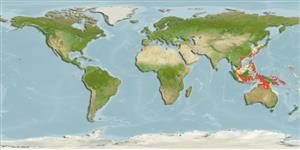
Western Pacific: Ryukyus, Japan and Indonesia.
Dimensione / Peso / Età
Maturità: Lm ? range ? - ? cm
Max length : 2.5 cm SL maschio/sesso non determinato; (Ref. 75136); 2.4 cm SL (female)
Breve descrizione
Chiavi di identificazione | Morfologia | Morfometria
Spine dorsali (totale) : 7; Raggi dorsali molli (totale) : 9 - 10; Spine anali: 1; Raggi anali molli: 9; Vertebre: 26. This species differs from the other species of the spinosa complex in having the following set of characters: cheek spines 6-10; all are short and the similar in size, length of longest spine 1.6-2.2% SL; first dorsal fin with no filamentous spines; distinct black spot on first dorsal fin absent; caudal fin base with a small vertically-elongate ovoid black spot; head and body, except for minute, dusky and slightly faded orange or yellow dots, have no vivid reddish orange spots ; underneath the eye is a distinct, narrow ventrally pointed vertical black bar (Ref. 75136); characterized further by absence of prolonged spines; longitudinal scale series 23-24; ctenoid scales on body, becoming cycloid anterior to pelvic and pectoral fins; rounded caudal fin; depth of body 4.0-4.4 in SL (Ref. 90102).
Body shape (shape guide): fusiform / normal; Cross section: compressed.
Occurs in coral-reef slopes, in protected bays, and found solitary on muddy or sandy-mud bottoms with dead-coral rubbles In the area. Associated with Its congener, A. atripes (Ref. 75136).
Ciclo vitale e comportamento di accoppiamento
Maturità | Riproduzione | Deposizione | Uova | Fecondità | Larve
Shibukawa, K. and T. Suzuki, 2007. Two new species of the cheek-spine goby genus Asterropteryx (Perciformes: Goiidae: Gobiinae) from the western Pacific. Bull. Natl. Mus. Nat. Sci., Ser. A, Suppl 1:109-121. (Ref. 75136)
Stato della Lista Rossa IUCN (Ref. 130435: Version 2025-2 (Global))
Minaccia per l'uomo
Harmless
Usi umani
Strumenti
Rapporti speciali
Scarica XML
Fonti Internet
Stime basate su modelli
Temperatura preferita (Fonte Biblio.
123201): 24.3 - 28.8, mean 27.8 °C (based on 218 cells).
Indice di diversità filogenetica (Fonte Biblio.
82804): PD
50 = 0.5020 [Uniqueness, from 0.5 = low to 2.0 = high].
Bayesian length-weight: a=0.01023 (0.00477 - 0.02194), b=3.01 (2.83 - 3.19), in cm total length, based on LWR estimates for this (Sub)family-body shape (Ref.
93245).
Livello trofico (Fonte Biblio.
69278): 3.3 ±0.4 se; based on size and trophs of closest relatives
Resilienza (Fonte Biblio.
120179): Alto, tempo minimo di raddoppiamento della popolazione meno di 15 mesi (Preliminary K or Fecundity.).
Vulnerabilità della pesca (Ref.
59153): Low vulnerability (10 of 100).
🛈