>
Gobiiformes (Gobies) >
Xenisthmidae (Collared wrigglers)
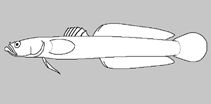
Etymology: Xenisthmus: Greek, xenos = strange + Greek, isthmos = throat, narrow passage (Ref. 45335); chi: Name from the Greek letter (chi), and refers to the X-shaped markings on the body; noun in apposition.
More on authors: Gill & Hoese.
Ambiente: milieu / zona climatica / distribuzione batimetrica / gamma di distribuzione
Ecologia
marino demersale. Tropical
Eastern Indian Ocean: Rowlwy Shoals, Timor Sea.
Dimensione / Peso / Età
Maturità: Lm ? range ? - ? cm
Max length : 2.1 cm SL maschio/sesso non determinato; (Ref. 59014); 2.2 cm SL (female)
Breve descrizione
Chiavi di identificazione | Morfologia | Morfometria
Spine dorsali (totale) : 7; Raggi dorsali molli (totale) : 12; Spine anali: 1; Raggi anali molli: 11; Vertebre: 26. This species is distinguished by the following characters: second dorsal-fin rays I, 12; A rays I,11; predorsal area broadly scaled to just behind vertical through posterior edge of preopercle, a narrow median wedge of scales extending further forward almost to pore D; posterior naris no flap on anterior rim; head and body pale with brown reticulate mottling, forming about 11 X-shaped markings along the sides, between pectoral and caudal-fin bases (Ref. 59014).
Body shape (shape guide): elongated.
A benthic, inshore species found in coral reefs (Ref. 75154).
Ciclo vitale e comportamento di accoppiamento
Maturità | Riproduzione | Deposizione | Uova | Fecondità | Larve
Gill, A.C. and D.F. Hoese, 2004. Three new Australian species of the fish genus Xenisthmus (Gobioidei: Xenisthmidae). Rec. Aust. Mus.56(2):241-246. (Ref. 59014)
Stato della Lista Rossa IUCN (Ref. 130435: Version 2025-2 (Global))
Minaccia per l'uomo
Harmless
Usi umani
Strumenti
Rapporti speciali
Scarica XML
Fonti Internet
Stime basate su modelli
Indice di diversità filogenetica (Fonte Biblio.
82804): PD
50 = 0.5010 [Uniqueness, from 0.5 = low to 2.0 = high].
Bayesian length-weight: a=0.00389 (0.00180 - 0.00842), b=3.12 (2.94 - 3.30), in cm total length, based on all LWR estimates for this body shape (Ref.
93245).
Livello trofico (Fonte Biblio.
69278): 3.1 ±0.4 se; based on size and trophs of closest relatives
Vulnerabilità della pesca (Ref.
59153): Low vulnerability (10 of 100).
🛈