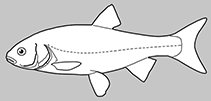
>
Cypriniformes (Carps) >
Leuciscidae (Minnows) > Leuciscinae
Etymology: Achondrostoma: Name refers to the absence of horny plate on the mouth; salmantinum: Derived from Salmantia, the Roman name for Salamanca, the Spanish city and the province where the species occurs.
Entorno: milieu / zona climática / rango de profundidad / gama de distribución
Ecología
; agua dulce bentopelágico; potamodromo (Ref. 138297). Temperate
Europe: Huebra, Turones and Uces rivers and their tributaries in the Duero basin, Spain.
Tamaño / Peso / Edad
Madurez: Lm ? range ? - ? cm
Max length : 6.8 cm SL macho / no sexado; (Ref. 75032); 8.1 cm SL (female)
Descripción breve
Claves de identificación | Morfología | Morfometría
Espinas dorsales (total) : 2 - 3; Radios blandos dorsales (total) : 6 - 7; Espinas anales: 2 - 3; Radios blandos anales: 6 - 7. Distinguished from all congeners by the following combination of characters: dorsal and anal fins with seven branched rays; pharyngeal teeth 5-5; narrow caudal peduncle; number of gill rakers 15-22 (mean = 18.4); lateral line scales 44-53 (mean = 49.1); scales on upper transverse line 9-10 (mean = 9.6); scales on lower transverse line 4-6 (mean = 5.5); four diagnostic isozyme loci (IDHP-2*, IDHP-3*, MDH-B* and PEP*) and one unique allele (MDHA*
95) (Ref. 75032).
Body shape (shape guide): fusiform / normal.
Adults occur in seasonal streams with clear waters, sandy bottoms and prefer slow flowing reaches with abundant aquatic macrophytes (Ref. 75032).
Ciclo vital y comportamiento de apareamiento
Madurez | Reproducción | Puesta | Huevos | Fecundidad | Larva
Doadrio, I. and B. Elvira, 2007. A new species of the genus Achondrostoma Robalo, Almada, Levy and Doadrio, 2007 (Actynopterigii, Cyprinidae) from Western Spain. Graellsia 63(2):295-304. (Ref. 75032)
Situación en la Lista Roja de la UICN (Ref. 130435: Version 2025-2 (Global))
Amenaza para el ser humano
Harmless
Usos humanos
Pesquerías: sin interés
Herramientas
Informes especiales
Descargar XML
Fuentes de Internet
Estimaciones basadas en modelos
Índice de diversidad filogenética (Referencia
82804): PD
50 = 0.5078 [Uniqueness, from 0.5 = low to 2.0 = high].
Bayesian length-weight: a=0.00724 (0.00353 - 0.01485), b=3.14 (2.97 - 3.31), in cm total length, based on LWR estimates for this (Sub)family-body shape (Ref.
93245).
Nivel trófico (Referencia
69278): 2.9 ±0.4 se; based on size and trophs of closest relatives
Resiliencia (Referencia
120179): Alto, población duplicada en un tiempo mínimo inferior a 15 meses (Preliminary K or Fecundity.).
Vulnerabilidad pesquera (Ref.
59153): Low vulnerability (10 of 100).
🛈