klasifikasi / Nama
Nama-nama umum | Sinonim (persamaan) | Catalog of Fishes(Marga, Jenis) | ITIS | CoL | WoRMS | Cloffa
>
Siluriformes (Catfishes) >
Loricariidae (Armored catfishes) > Hypoptopomatinae
Etymology: Curculionichthys: Derived from the from the Latin 'curculionem' (elongated snout) and from the Greek 'ichthys' (fishes), in reference to the relatively elongated snouts of the fish species included in this genus; luteofrenatus: From the Latin luteo (yellow), and frenatus (with bridle), in reference to the yellow pair of lines running dorsally on head from tip of snout to dorsal rim of orbit (Ref. 75061).
Lingkungan: lingkungan / zona iklim / kisaran kedalaman / jangkauan distribusi
Ekologi
; air tawar dasar (demersal). Tropical
South America: Upper Rio Tapajós basin in Brazil.
Ukuran / Berat / umur
Kematangan: Lm ? range ? - ? cm
Max length : 3.1 cm SL jantan/; (Ref. 75061)
deskripsi pendek
Kunci identifiaksi (pengenalan) | Morfologi | Morfometrik
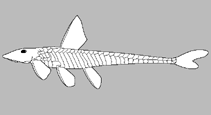
duri punggung lunak (Keseluruhan (total)) : 8; Sirip dubur lunak: 6. Diagnosed from all congeners, except Hisonotus insperatus, by having a pair of rostral plates at tip of snout. Distinguished from Hisonotus insperatus by having more teeth on premaxillary (12-30) and dentary bones (9-26) vs. (3-14) and (5-11). Can be differentiated from other species of the genus by the following combination of characters: longitudinal series with 25-26 plates; lateral line almost complete with 23-24 perforated plus last non-perforated plates; abdomen in adults entirely covered with large plates, five to eight plates in lateral series between tip of cleithrum and base of pelvic fin; large dark brown lateral stripe extending from tip of snout to caudal blotch; dorsum with basal dark blotch near origin of dorsal-fin region and three transverse dark brown bars located at end of dorsal-fin base, middle and end of caudal peduncle; yellow line extending from anterior part of each orbit, over inferior nostrils, both converging to tip of snout (Ref. 75061).
Body shape (shape guide): elongated.
Found in flat areas in creeks of headwaters of the Rio Tapajós in places of shallow clear waters with low current and sandy substrate, where the marginal vegetation is represented mainly by grass in deforested areas (Ref. 75061).
Siklus hidup dan perilaku kawin
Kematangan | Reproduksi, perkembang biakan | Pemijahan | telur-telur | Fekunditas | Larva
Britski, H.A. and J.C. Garavello, 2007. Description of two new sympatric species of the genus Hisonotus Eigenmann and Eigenmann, 1889, from upper Rio Tapajós, Mato Grosso state, Brazil (Pisces: Ostariophysi: Loricariidae). Brazilian Journal of Biology 67(3):413-420. (Ref. 75061)
Status IUCN Red List (Ref. 130435: Version 2025-2 (Global))
ancaman kepada manusia
Harmless
penggunaan manusia
Perikanan: tidak ada kepentingan
Alat, peralatan
laporan khas
muat turun XML
Sumber internet
Estimasi berdasarkan model
Indeks keanekaragaman filogenetik (Acuan
82804): PD
50 = 0.5001 [Uniqueness, from 0.5 = low to 2.0 = high].
Bayesian length-weight: a=0.00977 (0.00434 - 0.02202), b=3.06 (2.87 - 3.25), in cm total length, based on LWR estimates for this (Sub)family-body shape (Ref.
93245).
Tingkat Trofik (Acuan
69278): 2.4 ±0.1 se; based on size and trophs of closest relatives
Kerentanan Penangkapan Ikan (Ref.
59153): Low vulnerability (10 of 100).
🛈