>
Gymnotiformes (Knifefishes) >
Gymnotidae (Naked-back knifefishes) > Gymnotinae
Etymology: Gymnotus: Greek, gymnos = naked (Ref. 45335); chimarrao: Named for chimarrão, the traditional mate tea (Ilex paraguariensis) of Rio Grande do Sul, Brazil and neighboring counties.
State, Brazil.
Môi trường: môi trường / vùng khí hậu / Mức độ sâu / phạm vi phân phối
Sinh thái học
; nước ngọt sống nổi và đáy. Tropical
South America: Arroio Grande in the Rio Taquari drainage, Brazil.
Bộ gần gũi / Khối lượng (Trọng lượng) / Tuổi
Chín muồi sinh dục: Lm ? range ? - ? cm
Max length : 24.3 cm TL con đực/không giới tính; (Ref. 118108)
Mô tả ngắn gọn
Khóa để định loại | Hình thái học | Sinh trắc học
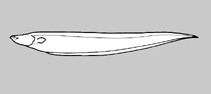
Tia mềm vây hậu môn: 180 - 213. Distinguished from all 32 congeners except for some specimens (over 30.0 cm) of Gymnotus ardilai from the Río Magdalena drainage in northwest South America in having a pigmentation pattern in which the oblique dark-pigmented bands are faint, and difficult to distinguish from the ground color. Diagnosed from Gymnotus ardilai in having a shallower body depth (7.4-9.1 % TL [mean 8.2] vs. 11.4-13.2 [12.3]). Differs also from all species in the Gymnotus pantherinus species-group (and is placed in the Gymnotus carapo species-group) by the presence of two (vs. one) laterosensory canal pores in the preopercular-mandibular series of the dorsoposterior portion of the preopercle. Can be differentiated from all species in the Gymnotus carapo species-group that occur south of the Amazon basin except Gymnotus inaequilabiatus in having a much shallower body depth (7.4-9.1 % TL [mean 8.2] vs. 8.9-11.6 [mean 11.1] in Gymnotus bahianus, 9.8-10.3 [mean 10.1] in Gymnotus paraguensis, and 10.3-13.1 [mean 11.7] in Gymnotus sylvius). Differs further from Gymnotus inaequilabiatus in possessing a substantially narrower head (53.1-59.3 % HL [mean 57.5] vs. 65.3- 72.0 [mean 67.8]) (Ref. 75065).
Facultative air-breathing in the genus (Ref. 126274); This species is known from a small stream, 1.5 m width, running through gallery forest in low hills, with altitude 54 m above mean sea level; substrate is mud and sand. All captured specimens were from marginal grasses rooted to the bottom of the stream in areas sheltered from the stream flow (with negligible current); dark-stained water; conductivity 107 μS·cm-1, temperature 24.1 °C (Ref. 75065)
Vòng đời và hành vi giao phối
Chín muồi sinh dục | Sự tái sinh sản | Đẻ trứng | Các trứng | Sự sinh sản | Ấu trùng
Cognato, D., M.M. Richer-de-Forges, J.S. Albert and W.G.R. Crampton, 2007. Gymnotus chimarrao, a new species of electric fish (Gymnotiformes: Gymnotidae) from southern Brazil. Ichthyol. Explor. Freshwat. 18(4):375-382. (Ref. 75065)
Tình trạng Sách đỏ IUCN (Ref. 130435: Version 2025-2 (Global))
Mối đe dọa đối với con người
Harmless
Sử dụng của con người
Các công cụ
Báo cáo đặc biệt
Tải xuống XML
Các nguồn internet
Ước tính dựa trên mô hình
Chỉ số đa dạng phát sinh loài (Tài liệu tham khảo
82804): PD
50 = 0.5000 [Uniqueness, from 0.5 = low to 2.0 = high].
Bayesian length-weight: a=0.00437 (0.00209 - 0.00911), b=2.98 (2.79 - 3.17), in cm total length, based on LWR estimates for this (Sub)family-body shape (Ref.
93245).
Mức dinh dưỡng (Tài liệu tham khảo
69278): 3.3 ±0.4 se; based on size and trophs of closest relatives
Thích nghi nhanh (Tài liệu tham khảo
120179): Chiêù cao, thời gian nhân đôi của chủng quần tối thiểu là dưới 15 tháng (Preliminary K or Fecundity.).
Sự dễ bị tổn thương của nghề đánh cá (Ref.
59153): Low vulnerability (14 of 100).
🛈