>
Anguilliformes (Eels and morays) >
Muraenidae (Moray eels) > Muraeninae
Etymology: Gymnothorax: Greek, gymnos = naked + Greek, thorax, -akos = breast (Ref. 45335).
More on author: Bleeker.
Окружающая среда: среда / климатическая зона / пределы глубины / диапазон распространения
экология
морской ассоциированный с рифами; пределы глубины 0 - 50 m (Ref. 30573). Tropical; 30°N - 25°S
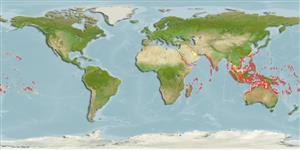
Indo-Pacific: Red Sea and East Africa (Ref. 33390) to the Marquesas and Oeno Atoll (Pitcairn Group), north to the Ryukyu and Hawaiian islands, south to New Caledonia and the Austral Islands.
Размер / Вес / Возраст
половая зрелость: Lm ? range ? - ? cm
Max length : 300 cm TL самец/пол неопределен; (Ref. 9710); наибольший вес (опубликованные данные): 30.0 kg (Ref. 30404)
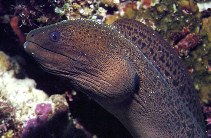
колючие лучи спинного плавника (общее число) : 0; колючие лучи анального плавника: 0; позвонки: 137 - 143. Juveniles are tan with numerous large black spots. Adults have black specks that grade into leopard-like spots behind the head and a black area surrounding the gill opening.
Body shape (shape guide): eel-like.
Found in lagoon and seaward reefs. Commonly seen species along deep drop-offs and slopes in Indonesian waters (Ref. 48635). Benthic (Ref. 58302). Juveniles more secretive and occur on intertidal reef flats (Ref. 37816). It feeds primarily on fishes and occasionally on crustaceans. This is the largest Indo-Pacific moray eel (Ref. 30404), perhaps reaching 3 m in length. Because of its position at the top of the reef's food chain it is often ciguatoxic. Attacks humans when provoked (Ref. 3132). Minimum depth reported taken from Ref. 10713. Solitary in reef holes (Ref 90102).
Жизненный цикл и брачное поведение
половая зрелость | размножение | нерест | икра | Плодовитость | личинки
Observations on prespawning behavior include a pair entwined around one another lying on the bottom of the reef area (Ref. 93344).
Chen, H.-M., K.-T. Shao and C.T. Chen, 1994. A review of the muraenid eels (Family Muraenidae) from Taiwan with descriptions of twelve new records. Zool. Stud. 33(1):44-64. (Ref. 6934)
Статус Красного Списка МСОП (Ref. 130435: Version 2025-2 (Global))
Угроза для людей
Reports of ciguatera poisoning (Ref. 4690)
Использование человеком
рыболовство: рыболовство как средство для существования; аквариум: общественные аквариумы
дополнительная информация
инструменты
Специальные отчеты
Скачать в формате XML
ресурсы в Интернет
Оценки, основанные на моделях
Предпочтительная температура (ссылка
123201): 25.5 - 29, mean 28.1 °C (based on 902 cells).
Индекс филогенетического разнообразия (ссылка
82804): PD
50 = 0.5000 [Uniqueness, from 0.5 = low to 2.0 = high].
Bayesian length-weight: a=0.00052 (0.00033 - 0.00084), b=3.28 (3.15 - 3.41), in cm total length, based on LWR estimates for this species & Genus-body shape (Ref.
93245).
Трофический уровень (ссылка
69278): 3.9 ±0.64 se; based on food items.
устойчивость к внешним воздействиям (ссылка
120179): высокий, минимальное время удвоения популяции до 15 месяцев (Fec = 200,000-300,000).
Уязвимость рыбной ловли (Ref.
59153): Very high vulnerability (90 of 100).
🛈
Питательные вещества (Ref.
124155): Calcium = 13.9 [6.4, 22.6] mg/100g; Iron = 0.337 [0.184, 0.805] mg/100g; Protein = 18.8 [16.5, 21.5] %; Omega3 = 0.0798 [, ] g/100g; Selenium = 66.2 [30.4, 144.6] μg/100g; VitaminA = 33.1 [8.1, 132.9] μg/100g; Zinc = 0.763 [0.513, 1.122] mg/100g (wet weight);