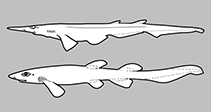
Klassifizierung / Names
Namen | Synonyme | Catalog of Fishes(Gattung, Arten) | ITIS | CoL | WoRMS | Cloffa
Elasmobranchii (Haie und Rochen) (sharks and rays) >
Carcharhiniformes (Ground sharks) >
Pentanchidae (Deepwater catsharks)
Etymology: Holohalaelurus: holos (Gr.), whole or entire, i.e., being a form of Halaeurus without any labial folds or grooves in the mouth (See ETYFish); grennian: From the old English grennian, grin, referring to its wide, broadly arched mouth and relatively large dentition, which resembles an “ominous grin” (See ETYFish).
Umwelt: Milieu / Klimazone / Tiefenbereich / Verbreitungsgebiet
Ökologie
seewasser pelagic-oceanic; tiefenbereich ? - 246 m (Ref. 75585). Subtropical
Western Indian Ocean: Kenya.
Größe / Gewicht / Alter
Geschlechtsreife: Lm ? range ? - ? cm
Max length : 27.3 cm TL Männchen/unbestimmt; (Ref. 83901); 25.7 cm TL (female)
Lebenszyklus und Paarungsverhalten
Geschlechtsreife | Fortpflanzung | Ablaichen | Eier | Fruchtbarkeit | Larven
Human, B.A., 2006. A taxonomic revision of the catshark genus Holohalaelurus Fowler 1934 (Chondrichthyes: Carcharhiniformes: Scyliorhinidae), with descriptions of two new species. Zootaxa 1315:1-56. (Ref. 75585)
IUCN Rote Liste Status (Ref. 130435: Version 2025-2 (Global))
Bedrohung für Menschen
Harmless
Nutzung durch Menschen
Tools
Zusatzinformationen
Download XML
Internet Quellen
Schätzungen auf der Grundlage von Modellen
Phylogenetischer Diversitätsindex (Ref.
82804): PD
50 = 0.5312 [Uniqueness, from 0.5 = low to 2.0 = high].
Bayesian length-weight: a=0.00347 (0.00172 - 0.00698), b=3.08 (2.90 - 3.26), in cm total length, based on LWR estimates for this (Sub)family-body shape (Ref.
93245).
Trophische Ebene (Ref.
69278): 4.0 ±0.5 se; based on size and trophs of closest relatives
Widerstandsfähigkeit (Ref.
120179): niedrig, Verdopplung der Population dauert 4,5 - 14 Jahre. (Preliminary low fecundity).
Anfälligkeit der Fischerei (Ref.
59153): Low vulnerability (17 of 100).
🛈