This website uses cookies to enhance your browsing experience and ensure the functionality of our site. For more detailed information about the types of cookies we use and how we protect your privacy, please visit our Privacy Information page.
×
Cookie Settings
This website uses different types of cookies to enhance your experience. Please select your preferences below:
分类 / 名称 俗名 | 同种异名 | Catalog of Fishes(属, 种) | ITIS | CoL | WoRMS | Cloffa
Teleostei > Cypriniformes (Carps) > Cobitidae (Spined loaches)
Etymology: Cobitis:Greek, kobitis, -idos = a kind of sardine; also related with the voice Greek, kobios, Latin gobius = gudgeon (Ref. 45335). More on author: Linnaeus.
Europe and Asia: Atlantic drainages from Loire northward; Baltic basin south of 61°N; upper olga and Ural drainages; northern Black Sea basin (except Danube). Ancient records from Ardour and Garonne drainages in France require confirmation (Ref. 59043). 歐洲與亞洲: 到西伯利亞的西班牙。 在伯恩公約的附錄 3 中 (受保育的動物群).
首次成熟时的长度 / 大小 / 重量 / 年龄
成熟度: Lm5.3, range 8 - ? cm Max length : 13.5 cm TL 雄鱼/尚未辨别雌雄; (Ref. 1441); 9.5 cm SL (female); common length : 5.0 cm TL 雄鱼/尚未辨别雌雄; (Ref. 556); 最大年龄: 5 年 (Ref. 59043)
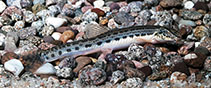
背棘 (总数) : 3; 背的软条 (总数) : 6 - 8; 臀棘: 3; 臀鳍软条: 5; 脊椎骨: 40 - 42. Caudal fin with 15-16 rays (Ref. 2196). Single small spot on upper caudal base. Pigmentation (Gambetta's longitudinal zone of pigmentation): zones Z1-Z4 usually well differentiated, extending backward to caudal peduncle; height of blotches of zone Z4 usually less than 2 times in their length; if more than 2 times, then height equal to or greater than horizontal eye diameter. One lamina circularis (Ref. 59043). Body shape (shape guide): elongated. 尾鳍有 15-16个鳍条。 (参考文献 2196)
Adults occur in slow-flowing and still waters with fine sandy substrate (Ref. 9696). They occur in the Baltic Sea at salinities of up to 5 ppt (Ref. 59043). Filter sand for food particles (Ref. 36876). Nocturnal, stays hidden under rocks or buried in the sand or mud during the day (Ref. 30578). Oviparous, with distinct pairing during breeding (Ref. 205). Spawn in spring; scatters eggs into mats of plant material (Ref. 36876). Eggs are found attached to gravel and weed in shallow, flowing water (Ref. 41678). Larvae hide under vegetation and in debris until beginning of exogenous feeding (Ref. 59043).
Start of courtship is observed when both male and female swim excitedly then progresses to a chase done by the male. When movements become synchronised, the male entwines itself around the female's body, squeezing it and causing egg spawning (Ref. 58425).
Triploid females can occur; they produce triploid eggs which can develop without fertilization, but need contact with sperm to start development (gynogenesis) (Ref. 36876). Also Ref. 9953.歐洲與亞洲: 到西伯利亞的西班牙。 在伯恩公約的附錄 3 中 (受保育的動物群).
系统发育多样性指数 (参考文献 82804): PD50 = 0.5000 [Uniqueness, from 0.5 = low to 2.0 = high].
Bayesian length-weight: a=0.00417 (0.00261 - 0.00667), b=3.14 (3.01 - 3.27), in cm total length, based on LWR estimates for this species & Genus-body shape (Ref. 93245).
营养阶层 (参考文献 69278): 3.3 ±0.4 se; based on size and trophs of closest relatives