分類 / 名稱
俗名 | 同種異名 | Catalog of Fishes(屬, 種) | ITIS | CoL | WoRMS | Cloffa
環境: 環境 / 氣候帶 / 深度上下限 / 配送範圍
生態學
; 淡水 居於水底的; pH range: 7.0 - 7.7; dH range: 10 - 15; 河川洄游 (Ref. 51243). 溫帶; ? - 18°C (Ref. 13371); 67°N - 39°N, 6°W - 59°E
Eurasia: Europe north of Caucasus, Pyrénées and Alps, from Loire and Rhone drainages eastward; British Isles ( except northern Scotland), southern Sweden and Finland (northward to about 66°N); northeastern Italy; Danube and Vardar drainages (Ref. 59043); Asia to China (Ref. 6111).
歐亞大陸: 廣泛地從愛爾蘭 (在那裡它被引入) 分佈了越過歐洲 (除了義大利人與伊伯利亞半島) 與亞洲到中國。 可能與 托氏條鰍〔Nemacheilus toni〕 同種, 西伯利亞石頭泥鰍它的分佈範圍從西伯利亞到日本.(參考文獻 4537)
大小 / 重量 / 年齡
成熟度: Lm ? range ? - ? cm
Max length : 21.0 cm TL 雄魚/尚未辨別雌雄; (Ref. 1441); common length : 12.0 cm SL 雄魚/尚未辨別雌雄; (Ref. 5504); 最大體重: 200.00 g (Ref. 5504); 最大年齡: 7 年 (Ref. 6111)
背棘 (總數) : 3; 背的軟條 (總數) : 6 - 8; 臀棘: 3; 臀鰭軟條: 5 - 6. Distinguished from its congeners in Europe by the following combination of characters: caudal fin usually slightly emarginate (truncate in a few populations); pelvic origin beneath dorsal origin or under branched dorsal rays 1-2; caudal peduncle depth 1.4-2.2 (usually 1.6-2.0) times in its length, 1.2-1.8 times in body depth; often lacking dark blotches along back between nape and dorsal (Ref. 59043).
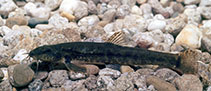
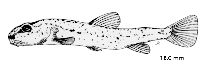
Body elongated, anteriorly somewhat depressed, posteriorly laterally compressed. Three pairs of mouth barbels. No erectile spine below eye. Posterior margin of caudal fin slightly notched. Caudal fin with 15-17 rays (Ref. 2196).
Body shape (shape guide): fusiform / normal; Cross section: circular.
身體延長, 前面地略微扁平的, 在後部側扁。 三對嘴觸鬚。 在眼之下的沒有直立的硬棘。 尾鰭後緣微凹。 尾鰭有 15-17個鰭條。 (參考文獻 2196)
Facultative or obligate air-breathing (Ref. 126274); Usually found in flowing stretches of streams and medium-sized rivers with gravel to stone bottom, but also in a variety of other habitats, including sandy canals and lake shores. Larvae are benthic. Larvae and small juveniles prefer sand bottom and slow current, shifting to gravel bottom and fast current when growing. Adults prey on relatively large benthic invertebrates such as gammarids, chironomids, insect larvae. They breed on gravel, sand or among aquatic vegetation. Tolerate moderate organic pollution and stream canalization and very sensitive to pollution by heavy metals (Ref. 59043). Sensitive to pollution and low oxygen levels, therefore, its presence in a river can be taken as an indication of good water quality (Ref. 6111).
棲息於淺灘,快速的流動小溪有礫石的底部; 也在清澈湖的水淺區域中.(參考文獻 556) 吃小型甲殼動物,昆蟲幼生與底棲的無脊椎動物。 在被脫落在石頭與水中植物之中的它的無光澤且白色卵的一些個別的產卵中,繁殖於四月-六月。 對污染與低溶氧量敏感,因此, 在一條河的它的出現能被作為一個好水質的指證。 (參考文獻 6111)
Spawns once a year for several years in low productivity streams, but exhibits multiple spawning within a season in high productivity environments (Ref. 40290, 40756). Releases eggs in open open water, often close to surface. Eggs drift and adhere to different substrates and are often covered by sand or detritus. Individual females may spawn daily for a short period (Ref. 59043).歐亞大陸: 廣泛地從愛爾蘭 (在那裡它被引入) 分佈了越過歐洲 (除了義大利人與伊伯利亞半島) 與亞洲到中國。 可能與 托氏條鰍〔Nemacheilus toni〕 同種, 西伯利亞石頭泥鰍它的分佈範圍從西伯利亞到日本.(參考文獻 4537)
Kottelat, M. and J. Freyhof, 2007. Handbook of European freshwater fishes. Publications Kottelat, Cornol and Freyhof, Berlin. 646 pp. (Ref. 59043)
IUCN 瀕危狀態 (Ref. 130435: Version 2025-2 (Global))
無危 (LC) ; Date assessed: 24 February 2023
人類使用
漁業: 低經濟; 水族館: 公眾的水族館; 誘餌: occasionally
工具
特別的報告
下載 XML
網路資源
基於模型的估計
系統發育多樣性指數 (參考文獻
82804): PD
50 = 0.5000 [Uniqueness, from 0.5 = low to 2.0 = high].
Bayesian length-weight: a=0.01096 (0.00427 - 0.02816), b=2.96 (2.74 - 3.18), in cm total length, based on LWR estimates for this (Sub)family-body shape (Ref.
93245).
營養階層 (參考文獻
69278): 3.3 ±0.0 se; based on diet studies.
Generation time: 4.6 ( na - na) years. Estimated as median ln(3)/K based on 1
growth studies.
回復力 (參考文獻
120179): 中等的, 族群倍增時間最少 1.4 - 4.4年 (tm=2-3).
釣魚的脆弱性 (Ref.
59153): Moderate vulnerability (37 of 100).
🛈