>
Perciformes/Zoarcoidei (Eelpouts and pricklebacks) >
Zoarcidae (Eelpouts) > Gymnelinae
Etymology: Bilabria: Latin, bi = two + Latin, labrum = lip (Ref. 45335); gigantea: Name from Latin ‘gigantis’ meaning large; refers to the species attaining the largest body size (to 40.8 cm TL) known for a gymneline eelpout.
Entorno: milieu / zona climática / rango de profundidad / gama de distribución
Ecología
marino bentopelágico; rango de profundidad 70 - 180 m (Ref. 75208). Temperate; 46°N - 41°N, 142°E - 144°E (Ref. 75208)
Northwest Pacific: Japan.
Tamaño / Peso / Edad
Madurez: Lm ? range ? - ? cm
Max length : 31.3 cm SL macho / no sexado; (Ref. 75208)
Descripción breve
Claves de identificación | Morfología | Morfometría
Radios blandos dorsales (total) : 117 - 126; Radios blandos anales: 98 - 107; Vértebra: 118 - 127. This species is distinguished with the following set of characters: interorbital pores 2-3; third supraorbital (supraoccipital) pore is present posteromesial to eye; usually no vomerine and palatine teeth; body and tail with characteristic W-shaped saddles; maximum length can reach over 40 cm SL (Ref. 75208).
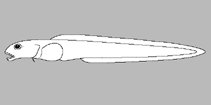
Body shape (shape guide): eel-like.
Ciclo vital y comportamiento de apareamiento
Madurez | Reproducción | Puesta | Huevos | Fecundidad | Larva
Anderson, M.E. and H. Imamura, 2008. Two new gymneline eelpouts (Perciformes: Zoarcidae) from Hokkaido, Japan. Bull. Natl. Mus. Nat. Sci. Ser. A. Suppl. 2:59-67. (Ref. 75208)
Situación en la Lista Roja de la UICN (Ref. 130435: Version 2025-2 (Global))
Amenaza para el ser humano
Harmless
Usos humanos
Herramientas
Informes especiales
Descargar XML
Fuentes de Internet
Estimaciones basadas en modelos
Índice de diversidad filogenética (Referencia
82804): PD
50 = 0.7500 [Uniqueness, from 0.5 = low to 2.0 = high].
Bayesian length-weight: a=0.00110 (0.00042 - 0.00285), b=3.09 (2.86 - 3.32), in cm total length, based on LWR estimates for this (Sub)family-body shape (Ref.
93245).
Nivel trófico (Referencia
69278): 3.3 ±0.4 se; based on size and trophs of closest relatives
Resiliencia (Referencia
120179): Bajo, población duplicada en un tiempo mínimo de 4.5-14 años (Preliminary K or Fecundity.).
Vulnerabilidad pesquera (Ref.
59153): Low to moderate vulnerability (28 of 100).
🛈