>
Perciformes/Uranoscopoidei (Sand dwellers) >
Pinguipedidae (Sandperches)
Etymology: Parapercis: Greek, para = the side of + Greek, perke = perch (Ref. 45335); katoi: Named for Kenji Kato, who caught and provided the color photographs of the holotype.
Eponymy: Kenji Kato of the Tokyo Metropolitan Fisheries Experiment Station caught the holotype (1991) with hook and line in the Ogasawara Islands. [...] (Ref. 128868), visit book page.
More on authors: Randall, Senou & Yoshino.
Ambiente: milieu / zona climática / intervalo de profundidade / gama de distribuição
Ecologia
marinhas bentopelágico; intervalo de profundidade 100 - 200 m (Ref. 75205). Temperate
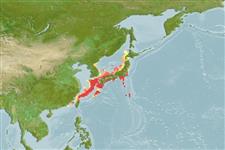
Northwest Pacific: Japan.
Tamanho / Peso / Idade
Maturidade: Lm ? range ? - ? cm
Max length : 17.7 cm SL macho/indeterminado; (Ref. 75205)
Descrição breve
Chaves de identificação | Morfologia | Morfometria
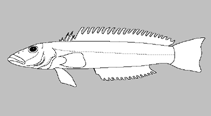
Espinhos dorsais (total) : 5; Raios dorsais moles (total) : 21; Espinhos anais: 1; Raios anais moles: 17; Vértebras: 30. This species is distinguished by the following characters: D V, 21; A I, 17; pectoral-fin rays 18; lateral-line scales 56/58; canine teeth 4 pairs anteriorly in lower jaw; without palatine teeth; vomer has a row of about 9 stout conical teeth, often followed by a few much smaller teeth; ctenoid scales on body, becoming cycloid on prepelvic but not prepectoral area; cycloid scales on opercle and cheek, those on cheek very small, mainly non-imbricate ventrally; preopercle with smooth margin; body depth 4.85-5.3 in SL; head length 3.15-3.25 in SL; snout length 2.5-2.9 in HL; orbit diameter 3.75-4.45 in HL; interorbital width 5.2-6.9 in HL; fourth dorsal spine is the longest, 4.5-5.35 in HL; caudal fin slightly rounded on ventral half, truncate on dorsal half, has a pointed upper lobe extending about an orbit diameter posterior to central margin of fin; pectoral fins 4.3-5.05 in SL; pelvic fins nearly or just reaching origin of anal fin, 4.7–5.0 in SL; preserved color in alcohol pale yellowish gray, 5 square dusky bars from dark pigment on scale edges on about upper one-fourth of body, a dark brown spot at each lower corner (except first bar with only 1); translucent pale yellowish fins with pale yellow rays, the caudal with a very small dusky spot dorsally on base; fresh color pale orange dorsally, white ventrally, with 5 broad pink bars on body, becoming red ventrally, each with brown spots as described; a broad, oblique red bar on cheek; fins pale yellowish, the dorsal with a faint longitudinal yellow band about half way out in fin; caudal fin with a narrow magenta bar at base containing a small deep purple spot dorsally and a red spot ventrally; pectoral fins has a white bar at base containing an elongate magenta spot; pelvic fins are nearly white (Ref. 75205).
Body shape (shape guide): elongated.
The gonad of the smallest paratype, 12.74 cm SL, appears to contain both ovarian and testicular tissue, indicating sex change from female to male. The lack of females is probably due to the larger males being able to take a larger baited hook (Ref. 75205)..
Ciclo de vida e comportamento de acasalamento
Maturidade | Reprodução | Desova | Ovos | Fecundidade | Larvas
Randall, J.E., H. Senou and T. Yoshino, 2008. Three new pinguipedid fishes of the genus Parapercis from Japan. Bull. Natl. Mus. Nat. Sci. Ser. A. Suppl. 2:69-84. (Ref. 75205)
Categoria na Lista Vermelha da IUCN (Ref. 130435: Version 2025-2 (Global))
Ameaça para o homem
Harmless
Utilização humana
Ferramentas
Relatórios especiais
Descarregue XML
Fontes da internet
Estimativas baseadas em modelos
Temperatura preferida (Ref.
123201): 5.7 - 20.5, mean 16.4 °C (based on 38 cells).
Índice de diversidade filogenética (Ref.
82804): PD
50 = 0.5000 [Uniqueness, from 0.5 = low to 2.0 = high].
Bayesian length-weight: a=0.00692 (0.00314 - 0.01524), b=3.06 (2.88 - 3.24), in cm total length, based on LWR estimates for this Genus-body shape (Ref.
93245).
Nível Trófico (Ref.
69278): 3.6 ±0.4 se; based on size and trophs of closest relatives
Resiliência (Ref.
120179): Elevada, tempo mínimo de duplicação da população menor que 15 meses (Preliminary K or Fecundity.).
Vulnerabilidade da pesca (Ref.
59153): Low vulnerability (12 of 100).
🛈