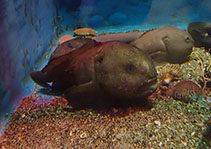
>
Perciformes/Cottoidei (Sculpins) >
Liparidae (Snailfishes)
Etymology: Careproctus: Greek, kara = face + Greek, proktos = anus (Ref. 45335); rotundifrons: Name from Latin ‘rotund’ for rounded and ‘frons’ meaning front; refers to its rounded forehead.
Ambiente: milieu / zona climatica / distribuzione batimetrica / gamma di distribuzione
Ecologia
marino batidemersale; distribuzione batimetrica 521 - 1100 m (Ref. 75204). Deep-water; 38°N - 34°N, 138°E - 142°E (Ref. 75204)
Northwest Pacific: Japan.
Dimensione / Peso / Età
Maturità: Lm ? range ? - ? cm
Max length : 10.8 cm SL maschio/sesso non determinato; (Ref. 75204); 104.4 cm SL (female)
Breve descrizione
Chiavi di identificazione | Morfologia | Morfometria
Raggi dorsali molli (totale) : 47 - 50; Raggi anali molli: 41 - 45; Vertebre: 53 - 56. This species is distinguished by the following characters: D 47-50; A 41-45; pectoral-fin rays 34-40; vertebrae 10-11+42-46=53-56; eye diameter 5.6-7.2% SL; disk length 4.6-7.1% SL; interorbital width 9.9-13.5% SL; outer margin of pectoral fin is slightly notched; pectoral radials 4 (3+1) without notches; ribs 2-3; scapula notch present; pyloric caeca 15-29; dark brown peritoneum; pale colored stomach, oral cavity, and pyloric caeca (Ref. 75204).
Body shape (shape guide): elongated.
Mature and immature specimens were captured by bait traps on the sea floor; apparently benthic. This is observed to swim searching for food fallen on the bottom and frequently to stay on the acrylic glass or walls of a tank using the ventral disk from individuals on display at Tokyo Sea Life Park. Captured together with A holosaurid (Aldrovandia affinis), a psychrolutid (Ebinania vermiculata), and 2 zoarcids (Ericandersonia sagamia and Japonolycodes abei) in the same traps in Sagami Bay, indicating the likelihood of their sharing similar habitat. Females have an ovipositor in the abdominal cavity and it is everted to outside the body when the abdominal cavity is pressed (Ref. 75204).
Ciclo vitale e comportamento di accoppiamento
Maturità | Riproduzione | Deposizione | Uova | Fecondità | Larve
Sakurai, H. and G. Shinohara, 2008. Careproctus rotundifrons, a new snailfish (Scorpaeniformes: Liparidae) from Japan. Bull. Natl. Mus. Nat. Sci. Ser. A. Suppl. 2:39-45. (Ref. 75204)
Stato della Lista Rossa IUCN (Ref. 130435: Version 2025-2 (Global))
Minaccia per l'uomo
Harmless
Usi umani
Pesca: di nessun interesse
Strumenti
Rapporti speciali
Scarica XML
Fonti Internet
Stime basate su modelli
Indice di diversità filogenetica (Fonte Biblio.
82804): PD
50 = 0.5000 [Uniqueness, from 0.5 = low to 2.0 = high].
Bayesian length-weight: a=0.00447 (0.00203 - 0.00984), b=3.17 (2.99 - 3.35), in cm total length, based on LWR estimates for this Genus-body shape (Ref.
93245).
Livello trofico (Fonte Biblio.
69278): 3.5 ±0.5 se; based on size and trophs of closest relatives
Resilienza (Fonte Biblio.
120179): Molto basso, tempo minimo di raddoppiamento della popolazione più di 14 anni (Preliminary K or Fecundity.).
Vulnerabilità della pesca (Ref.
59153): Very high vulnerability (76 of 100).
🛈