>
Ateleopodiformes (Jellynose fishes) >
Ateleopodidae (Jellynose fishes)
Etymology: Guentherus: From Albert Günther (1830-1914), author of fifty volumes about fishes life in the British Museum (Ref. 45335); katoi: Named for Mr. Tatsuya Kato who collected the holotype.
Eponymy: Dr Albert Karl Ludwig Gotthilf Günther (1830–1914) was a German-born British zoologist, ichthyologist and herpetologist. [...] (Ref. 128868), visit book page.
Ambiente: milieu / zona climatica / distribuzione batimetrica / gamma di distribuzione
Ecologia
marino batidemersale; distribuzione batimetrica 319 - 612 m (Ref. 75203). Temperate; 35°N - 26°N, 126°E - 138°E (Ref. 75203)
Northwest Pacific: Japan.
Dimensione / Peso / Età
Maturità: Lm ? range ? - ? cm
Max length : 69.4 cm SL maschio/sesso non determinato; (Ref. 75203)
Breve descrizione
Chiavi di identificazione | Morfologia | Morfometria
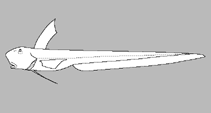
This species is characterized by the following: absence of lateral line and scales on body; head length 25.6-26.0% SL; orbit diameter 5.2-6.0% SL; upper jaw length 11.7-13.0% SL; dorsal fin length 20.9-23.9% SL; numerous dark brown spots on body; lanceolate and white tips of first and third free rays of pelvic fins (Ref. 75203).
Body shape (shape guide): fusiform / normal.
Ciclo vitale e comportamento di accoppiamento
Maturità | Riproduzione | Deposizione | Uova | Fecondità | Larve
Senou, H., S. Kuwayama and K. Hirate, 2008. A new species of the genus Guentherus (Ateleopodiformes: Ateleopodidae) from Japan. Bull. Natl. Mus. Nat. Sci. Ser. A. (Suppl. 2):13-19. (Ref. 75203)
Stato della Lista Rossa IUCN (Ref. 130435: Version 2025-2 (Global))
Minaccia per l'uomo
Harmless
Usi umani
Strumenti
Rapporti speciali
Scarica XML
Fonti Internet
Stime basate su modelli
Indice di diversità filogenetica (Fonte Biblio.
82804): PD
50 = 0.7501 [Uniqueness, from 0.5 = low to 2.0 = high].
Bayesian length-weight: a=0.01122 (0.00514 - 0.02450), b=3.04 (2.87 - 3.21), in cm total length, based on all LWR estimates for this body shape (Ref.
93245).
Livello trofico (Fonte Biblio.
69278): 4.1 ±0.7 se; based on size and trophs of closest relatives
Vulnerabilità della pesca (Ref.
59153): Moderate to high vulnerability (54 of 100).
🛈