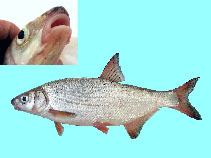
Entorno: milieu / zona climática / rango de profundidad / gama de distribución
Ecología
; agua dulce; salobre bentopelágico; anadromo (Ref. 138126). Subtropical; 10°C - 20°C (Ref. 2059); 64°N - 35°N, 12°E - 53°E
Eurasia: Caspian, Black, Marmara and Baltic Sea basins (Sweden and Finland north to 63°N), North Sea basin from Elbe to Ems drainages. In Anatolia: in Marmara basin, south to Great Menderes and Lake Egridir and east to Kızılırmak drainage. Absent between Kızılırmak and Çoruh drainages. Extirpated in Crimea. Introduced in Rhine.
Tamaño / Peso / Edad
Madurez: Lm ? range ? - ? cm
Max length : 50.0 cm TL macho / no sexado; (Ref. 556); common length : 20.0 cm TL macho / no sexado; (Ref. 556); peso máximo publicado: 1.4 kg (Ref. 35541); edad máxima reportada: 15 años (Ref. 59043)
Descripción breve
Claves de identificación | Morfología | Morfometría
Espinas dorsales (total) : 3; Radios blandos dorsales (total) : 8 - 9; Espinas anales: 3; Radios blandos anales: 16 - 22. Diagnosed from its congeners in Europe by the following characters: anal fin with 16-21½ branched rays; back keeled behind dorsal base; in spawning season, males blackish brown with orange cheek and sometimes belly (Ref. 59043). Caudal fin with 19 soft rays. Scalar formula: 49-64, 6-10 (Ref. 40476).
Body shape (shape guide): fusiform / normal.
Inhabits brackish estuaries, large to medium rivers and some large subalpine lakes. Sedentary populations inhabit even in small rivers or barbel zone. Feeds mainly on small molluscs and insect larvae. Breeds in riffles in shallow, fast-flowing streams and rivers on gravel. Semi-anadromous populations forage in freshened parts of sea and migrate for long distances to spawn. Lacustrine populations move to fast-flowing tributaries. Spent adults return to foraging habitats (Ref. 59043). Threatened from its range due to water obstruction (Ref. 26100).
Produces 15,000-20,000 eggs at the age of 6-7 years (Ref. 12259). Spawns for several years. Semi-anadromous populations undertake long distance spawning migrations while lacustrine populations migrate to fast-flowing tributaries. In Dniepr and Kuban, migration starts in September, decreases in winter and resumes in March-May (Ref. 59043).
Kottelat, M. and J. Freyhof, 2007. Handbook of European freshwater fishes. Publications Kottelat, Cornol and Freyhof, Berlin. 646 pp. (Ref. 59043)
Situación en la Lista Roja de la UICN (Ref. 130435: Version 2025-2 (Global))
Amenaza para el ser humano
Harmless
Usos humanos
Pesquerías: escaso valor comercial; Acuicultura: comercial; pesca deportiva: si
Herramientas
Informes especiales
Descargar XML
Fuentes de Internet
Estimaciones basadas en modelos
Índice de diversidad filogenética (Referencia
82804): PD
50 = 0.5625 [Uniqueness, from 0.5 = low to 2.0 = high].
Bayesian length-weight: a=0.00724 (0.00658 - 0.00798), b=3.14 (3.11 - 3.17), in cm total length, based on LWR estimates for this species (Ref.
93245).
Nivel trófico (Referencia
69278): 3.3 ±0.1 se; based on diet studies.
Resiliencia (Referencia
120179): Bajo, población duplicada en un tiempo mínimo de 4.5-14 años (K=0.22; tm=3; tmax=15).
Vulnerabilidad pesquera (Ref.
59153): Moderate vulnerability (37 of 100).
🛈