Elasmobranchii (tubarões e raias) (sharks and rays) >
Orectolobiformes (Carpet sharks) >
Hemiscylliidae (Bamboo sharks)
Etymology: Hemiscyllium: hemi-, from hemisys (Gr.), half, presumably referring to similarity and/ or close affinity to Scyllium (=Scyliorhinus, now in Scyliorhinidae) and/or Chiloscyllium; skylion, Greek for dogfish or small shark (See ETYFish); henryi: In honor of underwater photographer Wolcott Henry, who supported Conservation International’s marine initiatives, including the taxonomy of western New Guinea fishes (See ETYFish).
Eponymy: Wolcott Henry is a professional underwater photographer who is based in Washington DC. [...] (Ref. 128868), visit book page.
Ambiente: milieu / zona climática / intervalo de profundidade / gama de distribuição
Ecologia
marinhas associadas(os) a recifes; intervalo de profundidade 3 - 30 m (Ref. 74956). Tropical
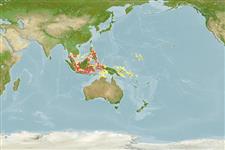
Western Pacific: Known only from western New Guinea (Papua Barat Province), Indonesia.
Tamanho / Peso / Idade
Maturidade: Lm ? range ? - ? cm
Max length : 78.3 cm TL macho/indeterminado; (Ref. 74956); 81.5 cm TL (female)
Descrição breve
Chaves de identificação | Morfologia | Morfometria
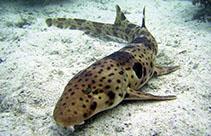
This species is distinguished by its unique colour pattern, distinctive is the combination of small scattered spots on the head, body and fins including 13-18 spots on the interorbital/dorsal snout region and 6-18 spots on dorsal surface of pectoral fins; a unique 'double-ocellus' marking on middle of side, just behind the head (Ref. 74956).
Body shape (shape guide): elongated.
Observed and collected both in the bay and at nearby Selat Iris, a narrow channel between the mainland and Aiduma Island; where there is almost no shallow, fringing reef habitat due to the unique geomorphology. Thus, the typical habitat for this species extends into deeper water (at least 30 m), although it has also been sighted in depths less than 4 m. It is often seen resting on the bottom, occasionally observed slowly swimming or 'walking' over the bottom with the pectoral and pelvic fins. Generally sedentary during the day, sheltering under rocky outcrops or tabular corals (Ref. 74956).
Ciclo de vida e comportamento de acasalamento
Maturidade | Reprodução | Desova | Ovos | Fecundidade | Larvas
Allen, G.R. and M.V. Erdmann, 2008. Two new species of bamboo sharks (Orectolobiformes: Hemiscylliidae) from western New Guinea. aqua, Int. J. Ichthyol. 13(3-4):93-108. (Ref. 74956)
Categoria na Lista Vermelha da IUCN (Ref. 130435: Version 2025-2 (Global))
Ameaça para o homem
Harmless
Utilização humana
Ferramentas
Relatórios especiais
Descarregue XML
Fontes da internet
Estimativas baseadas em modelos
Índice de diversidade filogenética (Ref.
82804): PD
50 = 0.5020 [Uniqueness, from 0.5 = low to 2.0 = high].
Bayesian length-weight: a=0.00407 (0.00182 - 0.00914), b=3.09 (2.89 - 3.29), in cm total length, based on LWR estimates for this (Sub)family-body shape (Ref.
93245).
Nível Trófico (Ref.
69278): 3.5 ±0.3 se; based on size and trophs of closest relatives
Vulnerabilidade da pesca (Ref.
59153): Moderate to high vulnerability (53 of 100).
🛈