>
Siluriformes (Catfishes) >
Ariidae (Sea catfishes) > Ariinae
Etymology: Cathorops: Greek, kathorao = to observe, to watch + Greek, ops = appearance (Ref. 45335); higuchii: Named for Dr. Horácio Higuchi, of Museu Paraense Emílio Goeldi, in recognition for his contribution to the taxonomy, systematics and morphology of South American Ariidae.
Eponymy: Dr Horácio Higuchi is an ichthyologist and evolutionary biologist. [...] (Ref. 128868), visit book page.
Environnement : milieu / zone climatique / profondeur / gamme de distribution
Écologie
marin; saumâtre démersal. Tropical
Western Central Atlantic: Honduras to Panama.
Taille / Poids / Âge
Maturité: Lm ? range ? - ? cm
Max length : 19.2 cm SL mâle / non sexé; (Ref. 75004)
Description synthétique
Clés d'identification | Morphologie | Morphométrie
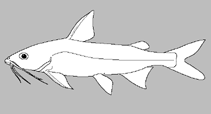
Rayons mous dorsaux (Total) : 7; Rayons mous anaux: 19 - 24. Differs from all congeners in having 18-21 gill rakers on first arch; slightly granulated cephalic shield; and orbit diameter 11.7-18.9% of external mental barbel length. Additional diagnostic characters include 17-21 gill rakers on second arch; snout length 6.1-8.0% SL; orbital diameter 3.3-4.4% SL; absence of fleshy papillae intercalated with gill rakers on first two gill arches; dorsal-fin spine length 18.6-22.2%SL; dorsal-fin spine longer than pectoral-fin spine; dorsal-fin spine length 35.6-43.3% of distance from tip of snout to pelvic-fin origin; nuchal plate length 6.3-7.5; width of posterior portion of supraoccipital process 2.7-3.3% SL; length of accessory tooth plates 2.6-4.7%SL; premaxilla width 5.7-7.7%SL; supraoccipital process length 3.1-4.5 in maxillary barbel length; supraoccipital process length 2.1-3.1 in external mental barbel length; distance from tip to snout to posterior margin of dorsomedian groove of neurocranium 20.9-26.3% SL; distance between lateral cornu of lateral ethmoid and external limb of the supracleithrum 20.4-25.9% SL and pelvic fin pale (Ref. 75004).
Occurs in shallow coastal areas and low portions of coastal rivers (Ref. 75004).
Cycle de vie et comportement reproducteur
Maturité | Reproduction | Frai | Œufs | Fécondité | Larves
Marceniuk, A.P. and R. Betancur-R, 2008. Revision of the species of the genus Cathorops (Siluriformes: Ariidae) from Mesoamerica and the Central American Caribbean, with description of three new species. Neotrop. Ichthyol. 6(1):25-44. (Ref. 75004)
Statut dans la liste rouge de l'IUCN (Ref. 130435: Version 2025-2 (Global))
Menace pour l'homme
Traumatogenic (Ref. 58010)
Utilisations par l'homme
Pêcheries: commercial
Outils
Articles particuliers
Télécharger en XML
Sources Internet
Estimations basées sur des modèles
Indice de diversité phylogénétique (Réf.
82804): PD
50 = 0.5000 [Uniqueness, from 0.5 = low to 2.0 = high].
Bayesian length-weight: a=0.00468 (0.00245 - 0.00892), b=3.13 (2.96 - 3.30), in cm total length, based on LWR estimates for this (Sub)family-body shape (Ref.
93245).
Niveau trophique (Réf.
69278): 4.2 ±0.8 se; based on size and trophs of closest relatives
Résilience (Réf.
120179): Haut, temps minimum de doublement de population inférieur à 15 mois (Preliminary K or Fecundity.).
Vulnérabilité de la pêche (Ref.
59153): Low vulnerability (13 of 100).
🛈