>
Acanthuriformes (Surgeonfishes) >
Leiognathidae (Slimys, slipmouths, or ponyfishes) > Gazzinae
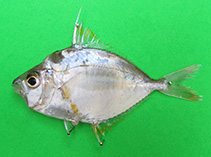
Etymology: flavaxilla: Name from Latin 'flavaxilla' which means 'yellow axil'. referting to the prominent yellowmarking just behind the pectoral fin base.
Milieu: milieu / Klimaatzone / Diepte / verspreidingsgebied
Ecologie
marien demersaal. Tropical; 12°N - 10°N, 122°E - 123°E
Western Central Pacific: Philippines.
Grootte / Gewicht / Leeftijd
Maturiteit: Lm ? range ? - ? cm
Max length : 10.9 cm SL mannelijk / geslacht onbekend; (Ref. 74926)
Dorsale stekels (totaal) : 8 - 9; Dorsale zachte stralen (totaal) : 15 - 17; Anale stekels: 3; Anale zachte stralen: 14. This species is distinguished by the following set of characters: naked cheek and breast; fully scaled dorsolateral body surface; anteroventral profile of lower jaw somewhat strongly concave; upper oral valve with sparse minute, slender papillary projections; bicuspid preorbital spine, not expanded distally; second dorsal and anal fin spines elongated,
almost reaching to the base of fifth dorsal fin soft ray and extending beyond the base of fifth anal fin soft ray when fins are appressed; a distinct yellow semicircular marking just behind pectoral fin base, larger than pupil and smaller than eye in size; usually almost straight dark vertical lines (not wavy) dorsolaterally on the body in preserved specimens (Ref. 74926).
Similar to Nuchequula gerroides and N. longicornis in overall body appearance, naked cheek and breast, and scaled anterior dorsolateral surface of body; however, N. flavaxilla is different from the latter two species by the preorbital spine not expanded distally (vs. expanded distally in the latter two species) (Ref. 74926).
Body shape (shape guide): short and / or deep; Cross section: compressed.
Levenscyclus en paargedrag
Maturiteit | Voortplanting | Paaien | Eieren | Fecunditeit | Larven
Kimura, S., R. Kimura and K. Ikejima, 2008. Revision of the genus Nuchequula with descriptions of three new species (Perciformes: Leiognathidae). Ichthyol. Res. 55:22-42. (Ref. 74926)
Status op de Rode Lijst van het IUCN (Ref. 130435: Version 2025-2 (Global))
Gebruik door de mens
Tools
Speciale rapporten
Download XML
Internetbronnen
Schattingen op basis van modellen
Fylogenetische diversiteitsindex (Ref.
82804): PD
50 = 0.5078 [Uniqueness, from 0.5 = low to 2.0 = high].
Bayesian length-weight: a=0.01905 (0.00857 - 0.04236), b=2.95 (2.77 - 3.13), in cm total length, based on LWR estimates for this (Sub)family-body shape (Ref.
93245).
Trofisch niveau (Ref.
69278): 2.9 ±0.3 se; based on size and trophs of closest relatives
Weerstandsvermogen (Ref.
120179): Hoog, minimale populatieverdubbelingstijd minder dan 15 maanden (Preliminary K or Fecundity.).
Kwetsbaarheid van de visserij (Ref.
59153): Low vulnerability (10 of 100).
🛈