>
Lophiiformes (Anglerfishes) >
Brachionichthyidae (Handfishes)
Etymology: Brachionichthys: Latin, bracchium = arm + Greek, ichthys = fish (Ref. 45335); australis: Name from Latin word 'australis' meaning southern; refers to its wide southern Australian distribution.
More on authors: Last, Gledhill & Holmes.
Ambiente: milieu / zona climatica / distribuzione batimetrica / gamma di distribuzione
Ecologia
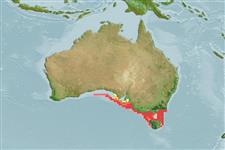
marino demersale; distribuzione batimetrica 18 - 277 m (Ref. 72490), usually 40 - 150 m (Ref. 72490). Subtropical; 33°S - 43°S, 128°E - 150°E
Southern Indian to Pacific: Australia.
Dimensione / Peso / Età
Maturità: Lm ? range ? - ? cm
Max length : 6.5 cm SL maschio/sesso non determinato; (Ref. 82446)
Breve descrizione
Chiavi di identificazione | Morfologia | Morfometria
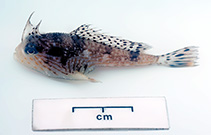
Raggi dorsali molli (totale) : 18 - 20; Raggi anali molli: 8 - 11. This species possess the following set of characters: esca small, 8-24% (mean 14%) of illicium length (including esca); illicium elongate, no dermal spinules, length 23-28% SL, 1.8-2.1 times in head length; eye large, mainly less than 5.4 times in head; body entirely covered with close-set, non-imbricate scales; scale bases subcircular with long unicuspid spinules (except for those closely associated with pores of the acoustico-lateralis system); spinules originating from middle of scale base, variable in length over body; second dorsal-fin rays 16-18 (mean 17), fin base 55-61% (mean 58%) SL; length of first ray of first dorsal fin 1.1-1.4 times length of longest ray of second dorsal fin; anal-fin rays usually 9-10; pectoral-fin rays 7; upper body lightly covered with longitudinal streak-like markings not spots; caudal fin with sparse coverage of large dark spots, not forming a broad submarginal bar (Ref. 72490).
Body shape (shape guide): elongated; Cross section: compressed.
This species is recorded from depths of 18 m to at least 210 m, commonly at about 40-150 m depth, but may occur deeper; one specimen was taken by a trawler fishing in 123-277 m, but the depth of capture cannot be determined. Newly hatched young and egg capsule diameter unknown; egg diameter 1.7-1.9 mm (Ref. 72490).
Ciclo vitale e comportamento di accoppiamento
Maturità | Riproduzione | Deposizione | Uova | Fecondità | Larve
Last, P.R., D.C .Gledhill and B.H. Holmes, 2007. A new handfish, Brachionichthys australis sp. nov. (Lophiiformes: Brachionichthyidae), with a redescription of the critically endangered spotted handfish, B. hirsutus (Lacepède). Zootaxa 1666:53-68. (Ref. 72490)
Stato della Lista Rossa IUCN (Ref. 130435: Version 2025-2 (Global))
Minaccia per l'uomo
Harmless
Usi umani
Pesca: bycatch
Strumenti
Rapporti speciali
Scarica XML
Fonti Internet
Stime basate su modelli
Temperatura preferita (Fonte Biblio.
123201): 13.9 - 16.4, mean 14.7 °C (based on 77 cells).
Indice di diversità filogenetica (Fonte Biblio.
82804): PD
50 = 0.7501 [Uniqueness, from 0.5 = low to 2.0 = high].
Bayesian length-weight: a=0.00437 (0.00164 - 0.01162), b=3.12 (2.89 - 3.35), in cm total length, based on LWR estimates for this (Sub)family-body shape (Ref.
93245).
Livello trofico (Fonte Biblio.
69278): 3.6 ±0.5 se; based on size and trophs of closest relatives
Vulnerabilità della pesca (Ref.
59153): Low vulnerability (10 of 100).
🛈