This website uses cookies to enhance your browsing experience and ensure the functionality of our site. For more detailed information about the types of cookies we use and how we protect your privacy, please visit our Privacy Information page.
×
Cookie Settings
This website uses different types of cookies to enhance your experience. Please select your preferences below:
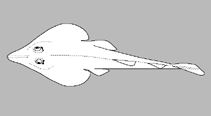
No image available for this species; drawing shows typical species in Rhinobatidae.
分類 / 名前 共通名の | 類義語 | Catalog of Fishes(部類, 種) | ITIS | CoL | WoRMS | Cloffa
板鰓亜鋼(サメとエイ類) (sharks and rays) > Rhinopristiformes (Shovelnose rays) > Rhinobatidae (Guitarfishes)
Etymology: Rhinobatos:Greek, rhinos = nose + Greek, batis, -idos = a ray (Raja sp.) (Ref. 45335); jimbaranensis:Named for its type locality, the Jimbaran Bay. More on authors: Last, White & Fahmi.
This species is defined by the following set of adult characters: disc wedge-shaped, width 32-33% TL, length more than 1.3 (1.35-1.39) times width; snout moderately elongate, length 3.4-3.6 times interspiracular distance, 5-5.5 times interorbital width; orbit medium-sized, 1.5-1.6 times spiracle length; nostrils weakly oblique, length 1.3-1.4 times internarial distance; preoral length 7.7-8.1 times internarial distance; anterior nasal flaps penetrating slightly into internarial space, however, well separated at their insertion; posterior nasal flaps broad; spiracular folds 2, outermost fold only slightly taller than inner fold; ridges of rostral cartilage almost parallel, converging slightly anteriorly but not constricted medially; anterior cartilage sickle shaped, pointed posteriorly; distance between fifth gill slits 3.1-3.4 times in ventral head length; prebranchial sensory pore patch obvious, extending to first gill slit; postscapular sensory canal obscure, without exposed lateral pores, not grooved; thorn patches on supraorbit, scapular region, and dorsal midline rudimentary, inconspicuous; inner margin of pelvic-fin slightly shorter than its base; interdorsal distance more than 2.5 (2.8-3.1) times first dorsal-fin base; dorsal caudal margin about 2.1 times preventral margin; upper jaw with 62-77 tooth rows; post-synarcual centra 176-180; nasal lamellae more than 50 (51-55); dorsal fin not distinctly bicolored; white spots absent on dorsal disc (Ref. 72461). Body shape (shape guide): elongated.
Demersal inshore on inner insular shelf. Mainly feeds on small crustaceans (Ref. 114953). The smallest pregnant female observed from this species was 74.7 cm TL; with pregnant females having 6-11 embryos, birth size unknown, but embryos well developed at 13 cm TL (Ref. 72461). Males mature at 77-80 cm TL. Females produces litters of 6-11 pups (Ref. 114953).
Last, P.R., W.T. White and Fahmi, 2006. Rhinobatos jimbaranensis and R. penggali, two new shovelnose rays (Batoidea: Rhinobatidae) from eastern Indonesia. Cybium 30(3):261-271. (Ref. 72461)
IUCNのレッドリストの状況は (Ref. 130435: Version 2025-2 (Global))
系統多様性指数 (参照 82804): PD50 = 0.5000 [Uniqueness, from 0.5 = low to 2.0 = high].
Bayesian length-weight: a=0.00295 (0.00150 - 0.00581), b=3.13 (2.96 - 3.30), in cm total length, based on LWR estimates for this (Sub)family-body shape (Ref. 93245).
栄養段階 (参照 69278): 3.8 ±0.4 se; based on size and trophs of closest relatives