Elasmobranchii (haaien en roggen) (sharks and rays) >
Squaliformes (Sleeper and dogfish sharks) >
Squalidae (Dogfish sharks)
Etymology: Squalus: Genus name from Latin 'squalus' meaning shark (Ref. 6885, 27436).
Eponymy: Whitley’s original description gives no etymology. [...] (Ref. 128868), visit book page.
More on author: Whitley.
Milieu: milieu / Klimaatzone / Diepte / verspreidingsgebied
Ecologie
marien bathydemersaal; diepte 154 - 1370 m (Ref. 58048), usually 383 - 670 m (Ref. 58441). Deep-water
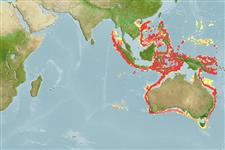
Eastern Indian Ocean to Pacific: warm temperate to tropical waters; Australia to the Philippines; north to Taiwan, including Indonesia.
Grootte / Gewicht / Leeftijd
Maturiteit: Lm ? range ? - ? cm
Max length : 84.0 cm TL mannelijk / geslacht onbekend; (Ref. 58441); 94.5 cm TL (female)
Korte beschrijving
Determinatiesleutels | Morfologie | Morfometrie
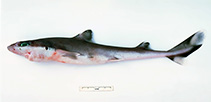
This large species of the ‘mitsukurii group’ is distinguished by the following set of characters: body elongate to robust, trunk depth 8.9-13.4% TL (mean 11.4% TL, n=14); snout is broadly triangular, with mouth width 1.69-2.32 (1.85) times the horizontal prenarial length; pre-first dorsal length 26.5-30.7 (29.0)% TL; pre-second dorsal length 57.6-62.8 (60.8)% TL; interdorsal space 21.7-25.9 (23.7)% TL; low raked dorsal fins; second dorsal-fin length 11.1-13.9 (12.4)% TL, height 3.4-4.6 (4.0)% TL, inner margin length 4.0-5.9 (4.8)% TL; second dorsal-fin base 15.8-21.3 (20.8) times the base of second dorsal spine; pre-pectoral length 20.8-22.9 (22.0)% TL; pelvic-caudal space 22.9-26.0 (24.0)% TL; caudal bar is almost upright, extending broadly from the caudal fork up the poster or margin of the upper lobe for about 0.6 of its length in immature specimens, upper caudal fringe forming a deep saddle along midlength of lobe; flank denticles tricuspid; monospondylous centra 41-47 (mainly 42-44), precaudal centra 79-85, total centra 105-114 (Ref. 58441).
Body shape (shape guide): elongated.
Occurs on or near the bottom of upper continental and insular slopes. Viviparous with yolk-sac dependency; gives birth to 4-16 pups, gestation unknown. Feeds mainly on small fishes, cephalopods, and crustaceans. Usually caught by demersal longline fisheries operating in deepwater. Marketed for its meat, fins, and liver oil which has a high value (Ref. 58048).
Levenscyclus en paargedrag
Maturiteit | Voortplanting | Paaien | Eieren | Fecunditeit | Larven
Distinct pairing with embrace (Ref. 205).
Last, P.R., W.T. White and H. Motomura, 2007. Description of Squalus chloroculus sp. nov., a new spurdog from southern Australia, and the resurrection of S. montalbani Whitley. p. 55-69. In P.R. Last, W.T. White and J.J. Pogonoski Descriptions of new dogfishes of the genus Squalus (Squaloidea:Squalidae). CSIRO Marine and Atmospheric Research Paper No. 014. 130 p. (Ref. 58441)
Status op de Rode Lijst van het IUCN (Ref. 130435: Version 2025-2 (Global))
Gevaar voor de mens
Harmless
Gebruik door de mens
Visserij: van potentieel belang
Tools
Speciale rapporten
Download XML
Internetbronnen
Schattingen op basis van modellen
Gewenste temperatuur (Ref.
123201): 6.6 - 11.9, mean 8.6 °C (based on 239 cells).
Fylogenetische diversiteitsindex (Ref.
82804): PD
50 = 0.5000 [Uniqueness, from 0.5 = low to 2.0 = high].
Bayesian length-weight: a=0.00347 (0.00163 - 0.00737), b=3.09 (2.92 - 3.26), in cm total length, based on LWR estimates for this Genus-body shape (Ref.
93245).
Trofisch niveau (Ref.
69278): 4.4 ±0.4 se; based on size and trophs of closest relatives
Weerstandsvermogen (Ref.
120179): Zeer laag, minimale populatieverdubbelingstijd meer dan 14 jaar (Preliminary K or Fecundity.).
Kwetsbaarheid van de visserij (Ref.
59153): High vulnerability (58 of 100).
🛈