Élasmobranches (requins et raies) (sharks and rays) >
Squaliformes (Sleeper and dogfish sharks) >
Squalidae (Dogfish sharks)
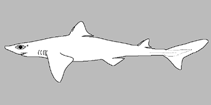
Etymology: Squalus: Genus name from Latin 'squalus' meaning shark (Ref. 6885, 27436); altipinnis: Name from Latin 'altus' for high and 'pinna' for fin, referring to the upright dorsal fin, typical of members in this 'highfin megalops group'.
More on authors: Last, White & Stevens.
Environnement : milieu / zone climatique / profondeur / gamme de distribution
Écologie
marin pelagic-oceanic; profondeur ? - 305 m (Ref. 58440). Tropical
Eastern Indian Ocean: off NW Australia.
Taille / Poids / Âge
Maturité: Lm ? range ? - ? cm
Max length : 58.9 cm TL mâle / non sexé; (Ref. 58440)
Description synthétique
Clés d'identification | Morphologie | Morphométrie
This species of the 'highfin megalops group' is distinguished by the following set of characters: abdomen depth 9.0-10.6% TL; pre-vent length 48.6-49.2% TL, about 2.5 times dorsal caudal margin; pre-second dorsal length 4.3-4.4 times pectoral-fin anterior margin, about 3.1 times dorsal caudal margin; head width about 1.5 times abdomen width; preoral length 2.9-3.2 times horizontal prenarial length, about 8.7% TL; head length 4.4-4.7 times eye length; mouth width 3.1-3.3 times length of upper labial furrow; interorbital width about 1.5 times horizontal preorbital length; fifth gill slit height 2.2-2.5% TL; strongly bifurcated anterior nasal flap; first dorsal fin upright, upper posterior margin directed posteroventrally, greatest concavity slightly closer to free rear tip than fin apex; posterior margin of second dorsal fin deeply concave; second dorsal-fin spine with a broad base; pectoral fin not falcate, anterior margin short, 13.9-14.1% TL; dorsal surface slightly darker than ventral surface, but tones not sharply demarcated on side of head; dorsal fins pale with paler tips; first dorsal-fin spine darker than base of soft portion of dorsal fin; caudal fin has a broad white posterior margin, caudal bar absent; flank denticles are weakly to moderately tricuspid; monospondylous centra 42-44, precaudal centra 88-92, total centra 114-120 (Ref. 58440).
Body shape (shape guide): elongated.
Cycle de vie et comportement reproducteur
Maturité | Reproduction | Frai | Œufs | Fécondité | Larves
Distinct pairing with embrace (Ref. 205).
Last, P.R., W.T. White and J.D. Stevens, 2007. New species of Squalus of the 'highfin megalops group' from the Australasian region. p. 39-53. In P.R. Last, W.T. White and J.J. Pogonoski Descriptions of new dogfishes of the genus Squalus (Squaloidea:Squalidae). CSIRO Marine and Atmospheric Research Paper No. 014. 130 p. (Ref. 58440)
Statut dans la liste rouge de l'IUCN (Ref. 130435: Version 2025-2 (Global))
Menace pour l'homme
Harmless
Utilisations par l'homme
Pêcheries: d'intérêt potentiel
Outils
Articles particuliers
Télécharger en XML
Sources Internet
Estimations basées sur des modèles
Indice de diversité phylogénétique (Réf.
82804): PD
50 = 0.5000 [Uniqueness, from 0.5 = low to 2.0 = high].
Bayesian length-weight: a=0.00347 (0.00163 - 0.00737), b=3.09 (2.92 - 3.26), in cm total length, based on LWR estimates for this Genus-body shape (Ref.
93245).
Niveau trophique (Réf.
69278): 4.2 ±0.3 se; based on size and trophs of closest relatives
Résilience (Réf.
120179): Faible, temps minimum de doublement de population : 4,5 à 14 années (Preliminary K or Fecundity.).
Vulnérabilité de la pêche (Ref.
59153): Moderate vulnerability (44 of 100).
🛈