>
Eupercaria/misc (Various families in series Eupercaria) >
Labridae (Wrasses) > Scarinae
Etymology: Scarus: Greek, skaros = a fish described by anciente writers as a parrot fish; 1601 (Ref. 45335); maculipinna: Named for its distinctive pattern of (black) spots on the fins (dorsal, anal and pectoral) of the initial phase of the species.
More on authors: Westneat, Satapoomin & Randall.
Environnement : milieu / zone climatique / profondeur / gamme de distribution
Écologie
marin récifal; profondeur 3 - 15 m (Ref. 72409). Tropical
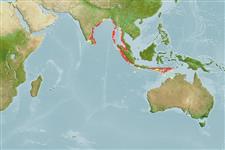
Eastern Indian Ocean: including the Andaman Sea and Mentawai Islands, Sumatra, Indonesia.
Taille / Poids / Âge
Maturité: Lm ? range ? - ? cm
Max length : 19.1 cm TL mâle / non sexé; (Ref. 72409)
Description synthétique
Clés d'identification | Morphologie | Morphométrie
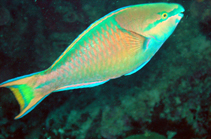
Épines dorsales (Total) : 8 - 9; Rayons mous dorsaux (Total) : 10; Épines anales: 3; Rayons mous anaux: 9; Vertèbres: 25. This species is distinguished with pectoral rays 14; dorsal rays IX, 10; anal rays III, 9 ; median pre-dorsal scales 4; scale rows on cheek 3, upper row with 6-7 scales, middle with 5 scales, and lower with 1 or 2 scales; a single laterally projecting canine on side of upper dental plates of adults; lips covering more than three-fourths of dental plates; dorsal fin moderately high, the longest dorsal spine 2.5 (2.1-3.0) in head length; caudal fin truncate in young, slightly emarginate in initial phase fish, and emarginate to lunate in terminal males; color of initial phase brown dorsally and on sides with abdomen pale to white below, two white stripes extending from behind eye to caudal peduncle, often a third white line below dorsal fin; snout and iris of eye yellowish, with a yellow patch covering base of pectoral fin; a distinctive black spot on anal fin, from the third anal spine to the second anal ray; a prominent black spot on second dorsal spine; a small black spot dorsally on base of pectoral fin; terminal-male phase complexly colored in blue-green, pink, and yellow with dark saddle extending from postorbital region to 4th dorsal spine and slanting anteroventrally to just behind pectoral fin base; head with a broad blue-green stripe on snout that divides to form a branch through upper eye, extending a short distance beyond, a branch through lower eye, extending on to opercle; chin and suborbital region pinkish yellow with a short transverse blue-green chin strap; an
irregular blue-green zone ventrally on head that continues broadly onto side of chest and anterior abdomen; body blue dorsally posterior to dark saddle, a midlateral blue-green stripe on caudal peduncle that joins a large blue-green crescent in caudal fin; dorsal fin with 4 color bands, red proximally, yellow, red, then blue marginally; anal fin red proximally and blue distally (Ref. 72409).
Body shape (shape guide): elongated; Cross section: compressed.
Occurs in shallow water on coral reefs with high coral cover; primarily on reef crest and slope habitats (Ref. 72409).
Cycle de vie et comportement reproducteur
Maturité | Reproduction | Frai | Œufs | Fécondité | Larves
Oviparous, distinct pairing during breeding (Ref. 205).
Westneat, M.W., U. Satapoomin and J.E. Randall, 2007. Scarus maculipinna, a new species of parrotfish (Perciformes, Scaridae) from the eastern Indian Ocean. Zootaxa 1628:59-68. (Ref. 72409)
Statut dans la liste rouge de l'IUCN (Ref. 130435: Version 2025-2 (Global))
Menace pour l'homme
Harmless
Utilisations par l'homme
Outils
Articles particuliers
Télécharger en XML
Sources Internet
Estimations basées sur des modèles
Température préférée (Réf.
123201): 28.3 - 29.4, mean 28.9 °C (based on 200 cells).
Indice de diversité phylogénétique (Réf.
82804): PD
50 = 0.5000 [Uniqueness, from 0.5 = low to 2.0 = high].
Bayesian length-weight: a=0.01122 (0.00482 - 0.02609), b=3.06 (2.88 - 3.24), in cm total length, based on LWR estimates for this Genus-body shape (Ref.
93245).
Résilience (Réf.
120179): Haut, temps minimum de doublement de population inférieur à 15 mois (Preliminary K or Fecundity.).
Vulnérabilité de la pêche (Ref.
59153): Low vulnerability (10 of 100).
🛈