Classificazione / Nomi
Nomi Comuni | Sinonimi | Catalog of Fishes(Genere, Specie) | ITIS | CoL | WoRMS | Cloffa
>
Cypriniformes (Carps) >
Cyprinidae (Minnows or carps) > Labeoninae
Etymology: Parasinilabeo: Greek, para = the side of + Latin, Sina, sinus = from China + Latin, labeo = who has large lips (Ref. 45335); longiventralis: From the Latin longus, meaning long and ventralis, meaning ventral, in reference to its longer pelvic fin.
More on authors: Huang, Chen & Yang.
Ambiente: milieu / zona climatica / distribuzione batimetrica / gamma di distribuzione
Ecologia
; acqua dolce benthopelagico. Tropical
Asia: Fuchuanjiang River, a tributary of the upper Hejiang River in Guangxi, China.
Dimensione / Peso / Età
Maturità: Lm ? range ? - ? cm
Max length : 8.5 cm SL maschio/sesso non determinato; (Ref. 72393)
Breve descrizione
Chiavi di identificazione | Morfologia | Morfometria
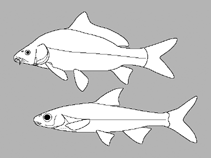
Raggi dorsali molli (totale) : 10; Raggi anali molli: 7. Differs from members of the genus by the following characters: maxillary barbels almost equal to rostral barbels; pelvic fin 83.7-89.4%, the distance between the ventral-fin origin to anal-fin origin; a longitudinal wide black stripe extends along the posterior lateral line; irregular brown pigments present on both sides of the body. Differs further from its congeners, except Parasinilabeo longcorpus by having pharyngeal teeth formula 2.3.5-5.3.2. Can be differentiated from Parasinilabeo assimilis by having more depressed body; from Parasinilabeo microps by having fewer lateral lines (38-39 vs. 41-44) and shorter caudal peduncle length (14.1-16.2% vs. 17.8-19.0% SL); from Parasinilabeo maculatus by its fewer lateral lines (38-39 vs. 40-42); fewer circumpeduncular scales (16 vs. 18); fewer branched dorsal-fin rays (7 vs. 8); shorter more slender caudal-peduncle, shorter snout (41.6-45.7% vs. 47.9-50.5% HL); larger eyes (24.8-27.4% vs. 19.4-23.6% HL) and the narrower interorbital space (41.9-47.7% vs. 51.8-56.1% HL); from Parasinilabeo longcorpus by its less slender body; and from Parasinilabeo longibarbus by having rostral cap with vertical grooves compared to smooth (Ref. 72393).
Found in the Karst area where many underground caves are connected to the surface river. Occurs in underground caves in the dry season and can swim to the surface river when the subterranean water flows out during the flood season (Ref. 72393).
Ciclo vitale e comportamento di accoppiamento
Maturità | Riproduzione | Deposizione | Uova | Fecondità | Larve
Huang, Y.-F., X.-Y. Chen and J.-X. Yang, 2007. A new labeonine fish species, Parasinilabeo longiventralis, from eastern Guangxi, China (Teleostei: Cyprinidae). Zool. Res. 28(5):531-538. (Ref. 72393)
Stato della Lista Rossa IUCN (Ref. 130435: Version 2025-2 (Global))
Minaccia per l'uomo
Harmless
Usi umani
Strumenti
Rapporti speciali
Scarica XML
Fonti Internet
Stime basate su modelli
Indice di diversità filogenetica (Fonte Biblio.
82804): PD
50 = 0.5156 [Uniqueness, from 0.5 = low to 2.0 = high].
Bayesian length-weight: a=0.00813 (0.00381 - 0.01735), b=3.05 (2.87 - 3.23), in cm total length, based on LWR estimates for this (Sub)family-body shape (Ref.
93245).
Resilienza (Fonte Biblio.
120179): Alto, tempo minimo di raddoppiamento della popolazione meno di 15 mesi (Preliminary K or Fecundity.).
Vulnerabilità della pesca (Ref.
59153): Low vulnerability (10 of 100).
🛈