>
Perciformes/Uranoscopoidei (Sand dwellers) >
Pinguipedidae (Sandperches)
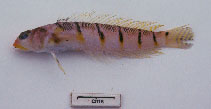
Etymology: Parapercis: Greek, para = the side of + Greek, perke = perch (Ref. 45335); sexlorata: Name from Latin word 'sex' for 6 and 'lorata' for strap, referring to the 6 distinctive narrow black strap-like bars across the back of this species.
Environnement : milieu / zone climatique / profondeur / gamme de distribution
Écologie
marin benthopélagique; profondeur 86 - 137 m (Ref. 59349). Tropical
Western Pacific: Australia.
Taille / Poids / Âge
Maturité: Lm ? range ? - ? cm
Max length : 12.0 cm SL mâle / non sexé; (Ref. 59349)
Description synthétique
Clés d'identification | Morphologie | Morphométrie
Épines dorsales (Total) : 4; Rayons mous dorsaux (Total) : 23; Épines anales: 1; Rayons mous anaux: 19; Vertèbres: 31 - 33. This species is distinguished by the following characters: Dorsal-fin rays IV,23; anal-fin rays I,19; pectoral-fin rays 19; lateral-line scales 53-57; gill rakers 4-6+8-10; predorsal scales 10-11; ctenoid scales on cheek, in about 9 horizontal rows below middle of eye; 6 canine teeth in outer row at front of lower jaw; vomer with a crescentic outer row of 6-7 robust conical teeth and several smaller teeth behind; palatines with a single row of about 7 robust conical teeth; angle of subopercle produced, with several feeble spinules; 9-10 abdominal and 22-23 caudal vertebrae; the head and body colored pink, with 6 narrow oblique posteroventrally-directed black bars across the back, the first extending to lateral line, and the second to middle of sides, others to lower third of body; a small black spot in upper corner of caudal-fin base; scales above lateral line in area between bars and spot with dusky margins; spinous dorsal fin membrane dusky; upper lip yellowish (Ref. 59349).
Body shape (shape guide): elongated.
Cycle de vie et comportement reproducteur
Maturité | Reproduction | Frai | Œufs | Fécondité | Larves
Johnson, J.W., 2006. Two new species of Parapercis (Perciformes: Pinguipedidae) from north-eastern Australia, and recovery of Parapercis colemani Randall & Francis, 1993. Mem. Mus. Victoria 63(1):47-56. (Ref. 59349)
Statut dans la liste rouge de l'IUCN (Ref. 130435: Version 2025-2 (Global))
Menace pour l'homme
Harmless
Utilisations par l'homme
Outils
Articles particuliers
Télécharger en XML
Sources Internet
Estimations basées sur des modèles
Indice de diversité phylogénétique (Réf.
82804): PD
50 = 0.5000 [Uniqueness, from 0.5 = low to 2.0 = high].
Bayesian length-weight: a=0.00692 (0.00314 - 0.01524), b=3.06 (2.88 - 3.24), in cm total length, based on LWR estimates for this Genus-body shape (Ref.
93245).
Niveau trophique (Réf.
69278): 3.5 ±0.4 se; based on size and trophs of closest relatives
Résilience (Réf.
120179): Haut, temps minimum de doublement de population inférieur à 15 mois (Preliminary K or Fecundity.).
Vulnérabilité de la pêche (Ref.
59153): Low vulnerability (10 of 100).
🛈