Classificatie / Namen
Lokale namen | Synoniemen | Catalog of Fishes(Genus, Soort(en)) | ITIS | CoL | WoRMS | Cloffa
>
Acanthuriformes (Surgeonfishes) >
Leiognathidae (Slimys, slipmouths, or ponyfishes) > Gazzinae
Etymology: laterofenestra: Name from Latin 'lateralis' meaning lateral/side and 'fenestra' meaning window, referring for its expansive transluscent lateral flank patch in males; noun in apposition.
Milieu: milieu / Klimaatzone / Diepte / verspreidingsgebied
Ecologie
marien demersaal; diepte 0 - 86 m (Ref. 59114). Tropical
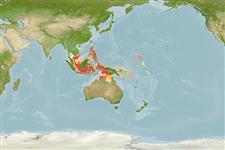
Western Pacific: Philippines, Malaysia, Indonesia, Australia. .
Grootte / Gewicht / Leeftijd
Maturiteit: Lm ? range ? - ? cm
Max length : 12.8 cm SL mannelijk / geslacht onbekend; (Ref. 59114)
Korte beschrijving
Determinatiesleutels | Morfologie | Morfometrie
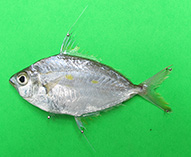
Dorsale stekels (totaal) : 8; Dorsale zachte stralen (totaal) : 16; Anale stekels: 3; Anale zachte stralen: 14; Wervels: 23. The males of this species are distinguished from all its congeners by possessing an expansive cornucopia-shaped translucent lateral flank patch, while both sexes can be further distinguished from P. elongatus and P. rivulatus, by the more or less bullet-shaped flank patch; a deeper body 34.4-39.2 (vs. 12.5-29.7% of SL); and, vermiculate pigmentation pattern on the upper flank with thin wavy lines forming semi-circles and oval shapes (vs. larger rounded blotches). Both sexes of this species differ from P. leuciscus and P. klunzingeri, by the triangular flank patch; absence of a markedly elongate second dorsal-fin spine; and the vermiculate pigmentation pattern on the upper flank, with thin wavy lines forming semi-circles and oval shapes (vs. speckled). Adults of both sexes of also grow to a larger size than congeners, except P. leuciscus (Ref. 59114).
Body shape (shape guide): short and / or deep; Cross section: compressed.
Levenscyclus en paargedrag
Maturiteit | Voortplanting | Paaien | Eieren | Fecunditeit | Larven
Sparks, J.S. and P. Chakrabarty, 2007. A new species of ponyfish (Teleostei: Leiognathidae: Photoplagios) from the Philippines. Copeia 2007(3):622-629. (Ref. 59114)
Status op de Rode Lijst van het IUCN (Ref. 130435: Version 2025-2 (Global))
Gevaar voor de mens
Harmless
Gebruik door de mens
Visserij: commercieel
Tools
Speciale rapporten
Download XML
Internetbronnen
Schattingen op basis van modellen
Gewenste temperatuur (Ref.
123201): 27.2 - 28.9, mean 28.5 °C (based on 42 cells).
Fylogenetische diversiteitsindex (Ref.
82804): PD
50 = 0.5002 [Uniqueness, from 0.5 = low to 2.0 = high].
Bayesian length-weight: a=0.01905 (0.00857 - 0.04236), b=2.95 (2.77 - 3.13), in cm total length, based on LWR estimates for this (Sub)family-body shape (Ref.
93245).
Trofisch niveau (Ref.
69278): 3.4 ±0.4 se; based on size and trophs of closest relatives
Weerstandsvermogen (Ref.
120179): Hoog, minimale populatieverdubbelingstijd minder dan 15 maanden (Preliminary K or Fecundity.).
Kwetsbaarheid van de visserij (Ref.
59153): Low vulnerability (10 of 100).
🛈