>
Perciformes/Scorpaenoidei (Scorpionfishes) >
Aploactinidae (Velvetfishes)
Etymology: Pseudopataecus: Name from Greek, 'pseudo' meaning false; referring to its false likeness to the pataecid genus Pataecus; taenianotus: Named for its long ribbon-like dorsal fin.
Ambiente: milieu / zona climatica / distribuzione batimetrica / gamma di distribuzione
Ecologia
marino benthopelagico; distribuzione batimetrica 20 - 40 m (Ref. 57897). Subtropical
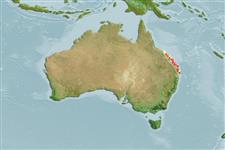
Southwestern Pacific: Australia.
Dimensione / Peso / Età
Maturità: Lm ? range ? - ? cm
Max length : 10.8 cm SL maschio/sesso non determinato; (Ref. 57897)
Breve descrizione
Chiavi di identificazione | Morfologia | Morfometria
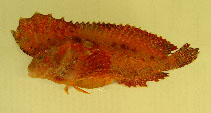
Spine dorsali (totale) : 13 - 15; Raggi dorsali molli (totale) : 14 - 15; Spine anali: 1; Raggi anali molli: 11 - 13. This species is distinguished by having the following characters: Dorsal fin XIII-XV, 14-15; anal fin I, 11-13; pectoral fin II; pelvic fin I, 3; all fin rays unbranched. Dorsal fin high, with membrane not or only slightly incised, anterior portion distinctly raised, originating on cranium almost one eye diameter before anterior margin of eye. Pelvic fins long and slender, reaching about two-thirds distance to anus. Head and body highly compressed, body width 6.4-6.9 in SL; frontal bone with non-prominent laterally-bowed ridges, a shallow fleshy depression in their interspace; fleshy cirri densely arranged on margin and ventral surface of mandible; anterior tip of isthmus tree; modified scales densely arranged on head and body; bands of minute villi form teeth in jaws and on vomer; no teeth on palatines; vertebrae 30 (Ref. 57897).
Body shape (shape guide): fusiform / normal; Cross section: compressed.
Taken by scallop trawls over predominantly sandy bottom, with some scattered shell and rubble. Brown algae Padina sp. and smaller amounts of the rubble and seagrasses Halophila ovalis and H. spinulosa, were recorded in the catch (Ref. 57897).
Ciclo vitale e comportamento di accoppiamento
Maturità | Riproduzione | Deposizione | Uova | Fecondità | Larve
Johnson, J.W., 2004. Two new species and two new records of aploactinid fishes (Pisces: Scorpaeniformes) from Australia. Rec. Aust. Mus. 56(2):179-188. (Ref. 57897)
Stato della Lista Rossa IUCN (Ref. 130435: Version 2025-2 (Global))
Minaccia per l'uomo
Harmless
Usi umani
Pesca: bycatch
Strumenti
Rapporti speciali
Scarica XML
Fonti Internet
Stime basate su modelli
Temperatura preferita (Fonte Biblio.
123201): 24.4 - 25.7, mean 24.7 °C (based on 9 cells).
Indice di diversità filogenetica (Fonte Biblio.
82804): PD
50 = 0.7500 [Uniqueness, from 0.5 = low to 2.0 = high].
Bayesian length-weight: a=0.01122 (0.00514 - 0.02450), b=3.04 (2.87 - 3.21), in cm total length, based on all LWR estimates for this body shape (Ref.
93245).
Livello trofico (Fonte Biblio.
69278): 3.5 ±0.4 se; based on size and trophs of closest relatives
Vulnerabilità della pesca (Ref.
59153): Low vulnerability (10 of 100).
🛈