Clasificación / Nombres
Nombres comunes | Sinónimos | Catalog of Fishes(Género, Especie) | ITIS | CoL | WoRMS | Cloffa
>
Siluriformes (Catfishes) >
Pseudopimelodidae (Bumblebee catfishes, dwarf marbled catfishes) > Batrochoglaninae
Etymology: Microglanis: Greek, mikros = small + Greek, glanis = a fish that can eat the bait without touching the hook; a cat fish (Ref. 45335); leptostriatus: Derived from the Greek lepto (slender) and striatus (stripe), in reference to the distinct light transverse stripe in the nuchal region.
Entorno: milieu / zona climática / rango de profundidad / gama de distribución
Ecología
; agua dulce demersal. Tropical
South America: São Francisco River basin in Brazil.
Tamaño / Peso / Edad
Madurez: Lm ? range ? - ? cm
Max length : 4.2 cm SL macho / no sexado; (Ref. 58766)
Descripción breve
Claves de identificación | Morfología | Morfometría
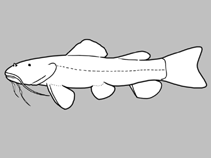
Espinas dorsales (total) : 1; Radios blandos dorsales (total) : 6; Radios blandos anales: 9 - 12. Distinguished from its congeners by the following combination of characters: light transverse stripe, situated in occipital region between the opercular openings, thin and sinuous, sometimes discontinuous; pale region below dorsal and adipose fins mottled with brown spots; dark stripe in the axis of gill filaments in alcohol preserved specimens. Differs further from Microglanis parahybae and Microglanis garavelloi, the closest species geographically, by the following combination of characters: longer head length (28.3-32.1% SL vs. 25.5-28.5% and 25.2-30.2, respectively), shorter dorsal spine length (11.7-14.9% SL vs. 14.1-18.1% and 11.3-19.0), shorter pectoral spine length (12.5-19.7% SL vs. 19.4-22.7% and 18.5-26.2) (Ref. 58766).
Body shape (shape guide): elongated.
Ciclo vital y comportamiento de apareamiento
Madurez | Reproducción | Puesta | Huevos | Fecundidad | Larva
Mori, H. and O.A. Shibatta, 2006. A new species of Microglanis Eigenmann, 1912 (Siluriformes, Pseudopimelodidae) from Rio São Francisco basin, Brazil. Zootaxa 1302:31-42. (Ref. 58766)
Situación en la Lista Roja de la UICN (Ref. 130435: Version 2025-2 (Global))
Amenaza para el ser humano
Harmless
Usos humanos
Herramientas
Informes especiales
Descargar XML
Fuentes de Internet
Estimaciones basadas en modelos
Índice de diversidad filogenética (Referencia
82804): PD
50 = 0.5000 [Uniqueness, from 0.5 = low to 2.0 = high].
Bayesian length-weight: a=0.00912 (0.00447 - 0.01861), b=3.17 (2.98 - 3.36), in cm total length, based on LWR estimates for this species & (Sub)family-body (Ref.
93245).
Nivel trófico (Referencia
69278): 3.3 ±0.4 se; based on size and trophs of closest relatives
Vulnerabilidad pesquera (Ref.
59153): Low vulnerability (10 of 100).
🛈