Klassificering / Namn
Populärnamn | synonymer | Catalog of Fishes(Släkte, Arter) | ITIS | CoL | WoRMS | Cloffa
>
Siluriformes (Catfishes) >
Ariidae (Sea catfishes) > Ariinae
Etymology: Cathorops: Greek, kathorao = to observe, to watch + Greek, ops = appearance (Ref. 45335); manglarensis: The specific epithet manglarensis makes reference to type-locality and life habit of the species, common in mangrove regions and estuaries from the Colombian Pacific (Ref. 58753).
Miljö: miljö / Klimatzon / djupintervall / distributionsområde
Ekologi
; sötvatten; brackvatten bentopelagisk. Tropical
South America: Colombia.
Storlek / Vikt / Ålder
Könsmognad: Lm ? range ? - ? cm
Max length : 19.5 cm SL hane/ej könsbestämd; (Ref. 58753); 19.5 cm SL (female)
Kort beskrivning
Bestämningsnycklar | Morfologi | Morfometri
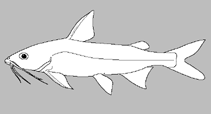
Cathorops manglarensis is distinguished from all congeners through the following combination of characters: 13-16 gill rakers on first arch; 24-27 anal fin rays; dorsal fin spine shorter than pectoral fin spine; posterior margin of pectoral fin spine with shorter serrations. This species can be further distinguished from each of the other species from the Pacific coast of Central and South America by additional characters. Cathorops manglarensis is distinguished from C. dasycephalus in lacking vomerine tooth plates (vs. vomerine tooth plates present) and an osseous bridge formed by the lateral ethmoid and frontal without granulation (vs. granulated along its entire extension). It differs from C. fuerthii by having a median groove of neurocranium deep and large, with lateral margins regular and progressively narrower posteriorly (vs. median groove narrow and shallow, with irregular margins along its entire extension), anterior nostrils closer to each other (3.6-4.8 vs. 4.9-6.0% SL), longer external mental barbel (19.7-24.4 vs. 15.9–19.7% SL), longer internal mental barbel (12.5–17.9 vs. 10.3–12.9% SL), and longer
anal fin base (21.0–24.5 vs. 17.8–19.4% SL). It differs from C. hypophthalmus in possessing a shorter distance between anterior nostrils (3.6–4.8 vs. 6.9–7.1% SL) and between posterior nostrils (5.2–7.1 vs. 8.2–8.5% SL), larger orbital diameter (3.7–4.8 vs. 3.0–3.5% SL), narrower mouth (8.8–10.5 vs. 13.1–13.2% SL) and with shorter external mental barbel (19.7–24.4 vs. 34.5–38.1% SL), internal mental barbel (12.5–17.9 vs.
26.1–31.2% SL), and dorsal fin spine (16.9–19.2 vs. 25.0–25.2% SL). Cathorops manglarensis differs from C. multiradiatus in possessing a longer maxillary barbel (28.4–38.2 vs. 22.9–27.7% SL) and pectoral fin spine (18.5–22.5 vs. 16.9–18.7% SL), and longer and wider accessory tooth plates with large and numerous molariform teeth (vs. shorter and narrow accessory tooth plates with small and few molariform teeth). Cathorops manglarensis differs from C. tuyra in possessing a longer internal mental barbel (12.5–17.9 vs. 8.20–12.4% SL) and pectoral fin spine (18.5–22.5 vs. 16.9–18.7% SL), shorter nuchal plate (5.0–6.8 vs. 6.8–7.5% SL), longer anal fin base (21.0–24.5 vs. 13.9–18.3% SL), deeper caudal peduncle (7.8–8.9 vs. 5.8–7.8% SL), and accessory tooth plates and dentary with moderately large molariform teeth (vs. accessory
tooth plates and dentary with very large molariform teeth) (Ref. 58753).
Livscykel och parningsbeteende
Könsmognad | Reproduktion | Lek | Ägg | Fekunditet | Larver
Marceniuk, A.P., 2007. Description of Cathorops manglarensis, a new species from the Colombian Pacific, with redescription of Cathorops multiradiatus (Siluriformes; Ariidae). Zootaxa 1529:33-48. (Ref. 58753)
Status på IUCN:s rödlista (Ref. 130435: Version 2025-2 (Global))
Hot mot människor
Traumatogenic (Ref. 58010)
Mänskliga användningsområden
Fiskeri: kommersiell
Verktyg
Särskilda rapporter
Ladda ner XML
Internet-källor
Uppskattningar baserade på modeller
Index för fylogenetisk mångfald (Ref.
82804): PD
50 = 0.5000 [Uniqueness, from 0.5 = low to 2.0 = high].
Bayesian length-weight: a=0.00468 (0.00245 - 0.00892), b=3.13 (2.96 - 3.30), in cm total length, based on LWR estimates for this (Sub)family-body shape (Ref.
93245).
Trofisk nivå (Ref.
69278): 4.2 ±0.8 se; based on size and trophs of closest relatives
Sårbarhet i fisket (Ref.
59153): Low vulnerability (14 of 100).
🛈