>
Anguilliformes (Eels and morays) >
Ophichthidae (Snake eels) > Ophichthinae
Etymology: Luthulenchelys: Named for Chief Albert John Mvumbi Luthuli of KwaZulu-Natal, Africa's first winner of the Nobel Peace Prize and former President of the African National Congress; and 'enchelys' from ancient Greek meaning eel, feminine; heemstraorum: Named for Phil and Elaine Heemstra.
Eponymy: Inkosi (Chief) Albert John ‘Mvumbi’ Luthuli (ca: 1898–1967) of KwaZulu-Natal was a politician, anti-apartheid activist, lay preacher and a teacher who was Africa’s first winner of the Nobel Peace Prize (1960) and former President of the African [...] Dr Phillip Clarence Heemstra (1941–2019) was an American/South African marine ichthyologist and scientific diver. [...] (Ref. 128868), visit book page.
More on author: McCosker.
Milieu: milieu / Klimaatzone / Diepte / verspreidingsgebied
Ecologie
marien benthopelagisch; diepte ? - 460 m (Ref. 58467). Tropical
Western Indian Ocean: presently known only from South Africa.
Grootte / Gewicht / Leeftijd
Maturiteit: Lm ? range ? - ? cm
Max length : 47.3 cm TL mannelijk / geslacht onbekend; (Ref. 58467)
Korte beschrijving
Determinatiesleutels | Morfologie | Morfometrie
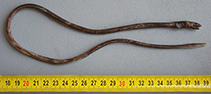
This species is distinguished by an body with tail 62%, head 7.2%, and body depth at gill opening 1.3% of total length; dorsal-fin origin nearly 2 head lengths behind pectoral-fin tips; pectoral fin elongate; posterior nostril a hole within upper lip, covered by a flap that extends below edge of lip; no barbels on upper lip and a no slit at posterior nostril; pores small
but conspicuous, SO 1 + 4, IO 4 + 2, POM5 + 2; teeth small and conical, biserial on upper jaw, uniserial on lower jaw, a single vomerine tooth; coloration uniform grey-black; vertebral formula 20/61/165. Counts and measurements of the holotype (in mm): total length 472; head 34.0; trunk 144; tail 294; predorsal distance 64; pectoral-fin length 8.25; pectoral base 2.4;
body depth ~6 at gill openings; body width ~6 at gill openings; body depth ~5 at anus; body width ~5 at anus; snout 7.5; tip of snout to rictus 11.2; snout overhang 3.5; eye diameter 3.0; interorbital width 3.5; gill opening height 3.1; isthmus width 2.6 (Ref. 58467).
Body shape (shape guide): eel-like.
Levenscyclus en paargedrag
Maturiteit | Voortplanting | Paaien | Eieren | Fecunditeit | Larven
McCosker, J.E., 2007. Luthulenchelys heemstraorum, a new genus and species of snake eel (Anguilliformes: Ophichthidae) from KwaZulu-Natal, with comments on Ophichthus rutidoderma (Bleeker, 1853) and its synonyms. Smithiana Bull. 7:3-7. (Ref. 58467)
Status op de Rode Lijst van het IUCN (Ref. 130435: Version 2025-2 (Global))
Gevaar voor de mens
Harmless
Gebruik door de mens
Tools
Speciale rapporten
Download XML
Internetbronnen
Schattingen op basis van modellen
Fylogenetische diversiteitsindex (Ref.
82804): PD
50 = 1.0000 [Uniqueness, from 0.5 = low to 2.0 = high].
Bayesian length-weight: a=0.00093 (0.00041 - 0.00214), b=2.99 (2.79 - 3.19), in cm total length, based on LWR estimates for this (Sub)family-body shape (Ref.
93245).
Trofisch niveau (Ref.
69278): 3.7 ±0.6 se; based on size and trophs of closest relatives
Weerstandsvermogen (Ref.
120179): Hoog, minimale populatieverdubbelingstijd minder dan 15 maanden (Preliminary K or Fecundity.).
Kwetsbaarheid van de visserij (Ref.
59153): Moderate vulnerability (37 of 100).
🛈