Klassificering / Namn
Populärnamn | synonymer | Catalog of Fishes(Släkte, Arter) | ITIS | CoL | WoRMS | Cloffa
>
Cypriniformes (Carps) >
Leuciscidae (Minnows) > Leuciscinae
Etymology: Pseudophoxinus: Greek, pseudes = false + Greek, phoxinos = a certain river fish (Ref. 45335); alii: Named for Ali, the author's father.
Eponymy: Ali Küçük is the father of the author, Turkish ichthyologist Fahrettin Küçük. (Ref. 128868), visit book page.
Miljö: miljö / Klimatzon / djupintervall / distributionsområde
Ekologi
; sötvatten pelagiska. Temperate
Asia: Turkey.
Storlek / Vikt / Ålder
Könsmognad: Lm ? range ? - ? cm
Max length : 13.5 cm TL hane/ej könsbestämd; (Ref. 93782); 14.3 cm TL (female); publicerad maxvikt: 33.70 g (Ref. 93782); publicerad maxvikt: 33.70 g
Kort beskrivning
Bestämningsnycklar | Morfologi | Morfometri
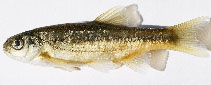
Ryggkotor: 37 - 39. Distinguished from all other large-scaled species of Pseudophoxinus in Anatolia by the following combination: lateral line incomplete; 38-41 perforated scales; 41-44 scales in lateral series; commonly 9 (rarely 8) scales between anus and anal-fin origin, 17-19 circumpeduncular scales, dorsal fin with 3-4 simple and 71/2 branched rays, anal fin with 3 simple 7-81/2 branched rays; mouth terminal or slightly subterminal, snout rounded, eye large, its diameter 26%-32% HL, head depth at nape 69%-89% HL; predorsal vertebrae 13-15, usually 14, comprising 59%-63% of abdominal vertebrae count, pelvic fins origin in front of the dorsal fin origin. Sexual dimorphism is pronounced; with spawning males generally darker and possess nuptial tubercles on dorsal and lateral surface of the head and along rays of the pectoral fin (Ref. 58389).
Body shape (shape guide): fusiform / normal.
Streams inhabited are fed with surface water and drain into the Mediterranean Sea. The riparian vegetation of the 15- to 17-km-long stream includes emergent aquatic plants and other trees; with bottom covered with sand, gravel and partly mud. The Aksu River is about 140 km long and begins from Eğirdir and Kovada Lakes. The bottom of the Karaöz region of Aksu River is completely covered with gravel and sand, and its riparian vegetation also includes emergent aquatic plants. Associated species found at some localities (Aksu River) include Anguilla anguilla, Cyprinus carpio, Capoeta antalyensis, Vimba vimba, Clarias gariepinus, and Aphanius mento. On the other hand, species living in the Ilõca and Kömürcüler streams are A. anguilla, Capoeta angorae, Alburnus baliki, and Salaria fluviatilis. Specimens were collected with portable electroshocker (Ref. 58389).
Livscykel och parningsbeteende
Könsmognad | Reproduktion | Lek | Ägg | Fekunditet | Larver
Küçük, F., 2007. Pseudophoxinus alii (Teleostei: Cyprinidae), a new fish species from the Antalya region, Turkey. Turk. J. Zool. 31(2007):99-106. (Ref. 58389)
Status på IUCN:s rödlista (Ref. 130435: Version 2025-2 (Global))
Hot mot människor
Harmless
Mänskliga användningsområden
Verktyg
Särskilda rapporter
Ladda ner XML
Internet-källor
Uppskattningar baserade på modeller
Index för fylogenetisk mångfald (Ref.
82804): PD
50 = 0.5000 [Uniqueness, from 0.5 = low to 2.0 = high].
Bayesian length-weight: a=0.00759 (0.00495 - 0.01162), b=3.17 (3.05 - 3.29), in cm total length, based on LWR estimates for this species & (Sub)family-body (Ref.
93245).
Trofisk nivå (Ref.
69278): 2.7 ±0.2 se; based on size and trophs of closest relatives
Resiliens (Ref.
120179): Mellan, lägsta populationsfördubblingstid 1,4-4,4 år (Preliminary K or Fecundity.).
Sårbarhet i fisket (Ref.
59153): Low vulnerability (10 of 100).
🛈