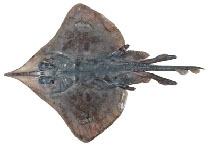
Zearaja maugeana, Maugean skate

You can sponsor this page

Zearaja maugeana Last & Gledhill, 2007

Maugean skate
Hochladen Photos und videos
Bilder | Google Bild
Image of Zearaja maugeana (Maugean skate)
Zearaja maugeana
Photo von Gledhill, D.

Klassifizierung / Names Namen | Synonyme | Catalog of Fishes(Gattung, Arten) | ITIS | CoL | WoRMS | Cloffa

Elasmobranchii (Haie und Rochen) (sharks and rays) > Rajiformes (Skates and rays) > Rajidae (Skates)
Etymology: maugeana: The epithet maugeana was derived to draw a link with the Australian cool temperate biogeographic region, the Maugean Province, in which this skate is a keystone species. Its common name, the Maugean Skate, follows this theme.
More on authors: Last & Gledhill.

Umwelt: Milieu / Klimazone / Tiefenbereich / Verbreitungsgebiet Ökologie

; brackwasser benthopelagisch. Temperate

Verbreitung Territorien | FAO Gebiete | Ökosysteme | Vorkommen | Punkt Karte | Einführungen | Faunafri

Southwest Pacific: Tasmania. Endemic to Bathurst and Macquarie Harbours, in southwestern Tasmania. Occurs primarily in the upper, oligo-mesohaline regions of these estuaries (Ref. 58362).

Größe / Gewicht / Alter

Geschlechtsreife: Lm ?  range ? - ? cm
Max length : 70.6 cm TL Männchen/unbestimmt; (Ref. 58362); 84.0 cm TL (female)

Biologie     Fachlexikon (Englisch) (z.B. epibenthic)

The total available habitat is less than 300 km2 and initial surveys suggest that the population is likely to be less than 1000 individuals (Treloar pers. comm.).

Lebenszyklus und Paarungsverhalten Geschlechtsreife | Fortpflanzung | Ablaichen | Eier | Fruchtbarkeit | Larven

Hauptreferenz Laden Sie Ihre Referenzen hoch | Referenzen | Koordinator : McEachran, John | Partner

Last, P.R. and D.C . Gledhill, 2007. The Maugean skate, Zearaja maugeana sp. nov. (Rajiformes: Rajidae) a micro-endemic, Gondwanan relict from Tasmanian estuaries. Zootaxa 1494:45-65. (Ref. 58362)

IUCN Rote Liste Status (Ref. 130435: Version 2025-2 (Global))

  stark gefährdet (EN) (B1ab(iii,iv,v)+2ab(iii,iv,v); C2a(ii)); Date assessed: 17 April 2025

CITES

Not Evaluated

CMS (Ref. 116361)

Not Evaluated

Bedrohung für Menschen

  Harmless


Nutzung durch Menschen

FAO - Publication: search | FishSource |

Mehr Information

Trophische Ökologie
Lebensmittel (Beutetiere)
Nahrungszusammensetzung
Nahrungsaufnahme
Lebensmittelrationen
Räuber
Ökologie
Ökologie
Populationsdynamik
Wachstumsparameter
Max. Alter/Größen
Länge-Gewicht-Rel.
Länge-Länge-Verhältnis.
Längenhäufigkeiten
Massenkonvertierung
Rekrutierung
Dichte
Lebenszyklus
Fortpflanzung
Geschlechtsreife
Reifung/Kiemen rel.
Fruchtbarkeit
Ablaichen
Laichaggregationen
Eier
Eientwicklung
Larven
Larven Pop.Dyn.
Verbreitung
Territorien
FAO Gebiete
Ökosysteme
Vorkommen
Einführungen
BRUVS - Videos
Anatomie
Kiemenoberfläche
Gehirn
Otolith
Physiologie
Körperliche Zusammensetzung
Nährstoffe
Sauerstoffverbrauch
Schwimmart
Schwimmgeschwindigkeit
Visuelle Pigmente
Fischgeräusche
Krankheiten und Parasiten
Toxizität (LC50s)
Genetik
Genom
Genetik
Heterozygotie
Vererbbarkeit
Genetische Vielfalt
Menschenbezogen
Aquakultur-Systeme
Aquakultur Profile
Zuchtlinien
Ciguatera-Fälle
Briefmarken, Münzen, Verschiedenes.
Aufsuchen
Partner
Taxonomie
Namen
Synonyme
Morphologie
Morphometrie
Bilder
Referenzen
Referenzen

Tools

Zusatzinformationen

Download XML

Internet Quellen

AFORO (otoliths) | Aquatic Commons | BHL | Cloffa | Websites from users | FishWatcher Einträge suchen | CISTI | Catalog of Fishes: Gattung, Arten | DiscoverLife | ECOTOX | FAO - Publication: search | Faunafri | Fishipedia | Fishtrace | GloBI | Google Books | Google Scholar | Google | IGFA World Record | OneZoom | Open Tree of Life | Otolith Atlas of Taiwan Fishes | PubMed | Reef Life Survey | Socotra Atlas | TreeBase | Tree of Life | Wikipedia: Gehe zu, Suchen | World Records Freshwater Fishing | Zoobank | Zoologischer Rekord

Schätzungen auf der Grundlage von Modellen

Phylogenetischer Diversitätsindex (Ref. 82804):  PD50 = 0.5625   [Uniqueness, from 0.5 = low to 2.0 = high].
Bayesian length-weight: a=0.00302 (0.00141 - 0.00645), b=3.24 (3.07 - 3.41), in cm total length, based on LWR estimates for this (Sub)family-body shape (Ref. 93245).
Trophische Ebene (Ref. 69278):  3.9   ±0.6 se; based on size and trophs of closest relatives
Widerstandsfähigkeit (Ref. 120179):  niedrig, Verdopplung der Population dauert 4,5 - 14 Jahre. (Preliminary K or Fecundity.).
Anfälligkeit der Fischerei (Ref. 59153):  Moderate to high vulnerability (54 of 100). 🛈