Elasmobranquios (tiburones y rayas) (sharks and rays) >
Myliobatiformes (Stingrays) >
Dasyatidae (Stingrays) > Urogymninae
Etymology: Urogymnus: Greek, oura = tail + Greek, gymnos = naked (Ref. 45335); lobistoma: Name from Latin 'lobus' for elongated projection or protuberance and 'stoma' for mouth, refers to its protrusible, tubelike mouth.
More on authors: Manjaji-Matsumoto & Last.
Entorno: milieu / zona climática / rango de profundidad / gama de distribución
Ecología
marino bentopelágico. Tropical
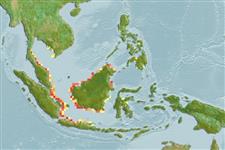
Indo-Malay Archipelago: from Sumatra to Borneo.
Tamaño / Peso / Edad
Madurez: Lm ? range ? - ? cm
Max length : 49.2 cm WD macho / no sexado; (Ref. 58327); 100.0 cm WD (female)
Descripción breve
Claves de identificación | Morfología | Morfometría
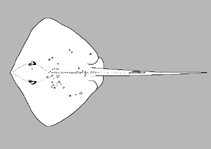
This species belong to the 'uarnacoides' complex, characterized by the following: lateral disc shape with pectoral fin apices broadly rounded rather than narrowly rounded or angular; color plain (usually uniform light to dark brown dorsally, and pale or whitish ventrally with or without a dark margin; a long and slender whiplike tail and platelike denticles in a broad dorsal band in adults. This species differs from H. hortlei in having a highly protrusible mouth and a pelvic girdle with prominent lateral prepelvic processes (Ref. 58327).
Body shape (shape guide): other.
An inshore species which I s probably with restricted distribution in brackish habitats that are associated with runoff from large rivers. Feeds on small fishes and prawns. Males mature at ca. 49 cm WD, females at ca. 70 cm WD; born at ca. 19 cm WD (Ref. 114953). Female maturity based on a pregnant female; males apparently smaller than females; full term pup 18.4 cm DW (Ref. 58327).
Ciclo vital y comportamiento de apareamiento
Madurez | Reproducción | Puesta | Huevos | Fecundidad | Larva
Manjaji-Matsumoto, B.M. and P.R. Last, 2006. Himantura lobistoma, a new whipray (Rajiformes: Dasyatidae) from Borneo, with comments on the status of Dasyatis microphthamus. Ichthyol. Res. 53(3):290-297. (Ref. 58327)
Situación en la Lista Roja de la UICN (Ref. 130435: Version 2025-2 (Global))
Amenaza para el ser humano
Harmless
Usos humanos
Herramientas
Informes especiales
Descargar XML
Fuentes de Internet
Estimaciones basadas en modelos
Temperatura preferida (Referencia
123201): 28.2 - 29.1, mean 28.8 °C (based on 232 cells).
Índice de diversidad filogenética (Referencia
82804): PD
50 = 0.5156 [Uniqueness, from 0.5 = low to 2.0 = high].
Bayesian length-weight: a=0.01023 (0.00482 - 0.02174), b=3.06 (2.86 - 3.26), in cm total length, based on LWR estimates for this (Sub)family-body shape (Ref.
93245).
Nivel trófico (Referencia
69278): 3.5 ±0.4 se; based on size and trophs of closest relatives
Vulnerabilidad pesquera (Ref.
59153): Very high vulnerability (90 of 100).
🛈