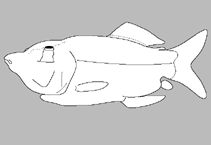
Classification / Noms
Noms communs | Synonymes | Catalog of Fishes(Genre, Espèce) | ITIS | CoL | WoRMS | Cloffa
>
Argentiniformes (Marine smelts) >
Opisthoproctidae (Barreleyes or spookfishes)
Etymology: Dolichopteryx: Greek, dolichos = long + Greek, pteryx, = wing, fin (Ref. 45335).
Eponymy: Dr Ivan Andreevich Trunov (1936–2005) was a Russian ichthyologist who for his entire career was at the Atlantic Research Institute of Fisheries and Oceanography and was finally a Senior Researcher there. [...] (Ref. 128868), visit book page.
Environnement : milieu / zone climatique / profondeur / gamme de distribution
Écologie
marin bathypélagique; profondeur 675 - 900 m (Ref. 54806). Deep-water
Southern hemisphere: Probably circumglobal. High Seas only.
Taille / Poids / Âge
Maturité: Lm ? range ? - ? cm
Max length : 14.3 cm SL mâle / non sexé; (Ref. 54806)
Description synthétique
Clés d'identification | Morphologie | Morphométrie
Rayons mous dorsaux (Total) : 11; Rayons mous anaux: 10; Vertèbres: 46 - 47. This species is characterized by myomeres 48; anal fin beginning after the vertical of the dorsal fin end (Ref. 54806); eye shape, tubular and adipose fin present (Ref. 58272).
Cycle de vie et comportement reproducteur
Maturité | Reproduction | Frai | Œufs | Fécondité | Larves
Parin, N.V., 2005. Dolichopteryx trunovi sp. nova - a new name for D. anascopa (nec Brauer, 1901) Trunov, 1997 (Opisthoproctidae, Argentinoidea). J. Ichthyol. 45(1):132-133. (Ref. 54806)
Statut dans la liste rouge de l'IUCN (Ref. 130435: Version 2025-2 (Global))
Menace pour l'homme
Harmless
Utilisations par l'homme
Pêcheries: bycatch
Outils
Articles particuliers
Télécharger en XML
Sources Internet
Estimations basées sur des modèles
Indice de diversité phylogénétique (Réf.
82804): PD
50 = 0.5020 [Uniqueness, from 0.5 = low to 2.0 = high].
Bayesian length-weight: a=0.00437 (0.00169 - 0.01126), b=3.10 (2.88 - 3.32), in cm total length, based on LWR estimates for this (Sub)family-body shape (Ref.
93245).
Niveau trophique (Réf.
69278): 3.7 ±0.1 se; based on size and trophs of closest relatives
Résilience (Réf.
120179): Milieu, temps minimum de doublement de population : 1,4 à 4,4 années (Preliminary K or Fecundity.).
Vulnérabilité de la pêche (Ref.
59153): Low vulnerability (10 of 100).
🛈