Classificazione / Nomi
Nomi Comuni | Sinonimi | Catalog of Fishes(Genere, Specie) | ITIS | CoL | WoRMS | Cloffa
>
Blenniiformes (Blennies) >
Tripterygiidae (Triplefin blennies) > Tripterygiinae
Etymology: Tripterygion: Greek, tres tria = three + Greek, pteron = wing, fin; diminutive (Ref. 45335); tartessicum: Named for the old Spanish culture (Tartessos, at least dating from 1000 BC), located on the south coast of the Iberian peninsula (in modern Andalusia, Spain), where the new species is partially distributed.
Ambiente: milieu / zona climatica / distribuzione batimetrica / gamma di distribuzione
Ecologia
marino demersale; distribuzione batimetrica 0 - 6 m (Ref. 58124), usually 0 - 3 m (Ref. 58124). Tropical
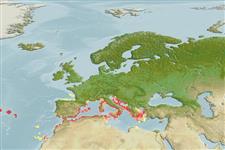
Mediterranean and Eastern Central Atlantic: along the southern coast of Spain, from Plage David (Morocco) to Tunisia.
Dimensione / Peso / Età
Maturità: Lm ? range ? - ? cm
Max length : 7.7 cm TL maschio/sesso non determinato; (Ref. 58124)
Breve descrizione
Chiavi di identificazione | Morfologia | Morfometria
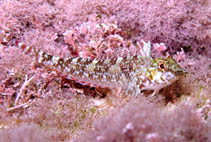
Spine dorsali (totale) : 19 - 21; Raggi dorsali molli (totale) : 12 - 13; Spine anali: 2; Raggi anali molli: 22 - 24. This species has an elongated and compressed body, greatest height at base of anal fin, being about one-sixth total length. Entire body with ctenoid scales except base of pectoral fin and ventral abdominal region back to vent. Lateral line with an anterior section with 20 (19-22) pored scales, and a posterior section with 22 (21-24) notched scales, total of 42 (40-46). Upper, anterior, section commencing at upper angle of opercular opening, slightly curving up over the pectoral fin base and running parallel to the dorsal profile to a point below last 1-3 rays of second dorsal fin; canal running across exposed width of each scale. Lower,
posterior, section commencing below, and in front of last scale or two of upper section, running along the mid-line of tail to caudal fin base; each scale with shallow notch in free-edge tip (Ref. 58124).
Adults inhabit similar habitats to Tripterygion tripteronotus, shallow rocky shores to 6 m,
preferably between 0 and 3 m; in light-exposed and shady biotopes dominated by algal communities (e.g. Corallina elongata, Cladophora spp., Litophyllum spp., Enteromorpha spp.). Nests are usually situated in sciaphyl habitats dominated by
steep rocky zones, without arborescent algae (Ref. 58124). Eggs are hemispherical and covered with numerous sticky threads that anchor them in the algae on the nesting sites (Ref. 240). Larvae are planktonic which occur primarily in shallow, nearshore waters (Ref. 94114).
Ciclo vitale e comportamento di accoppiamento
Maturità | Riproduzione | Deposizione | Uova | Fecondità | Larve
Carreras-Carbonell, J., M. Pascual and E. Macpherson, 2007. A review of the Tripterygion tripteronotus (Risso, 1810) complex, with a description of a new species from the Mediterranean Sea (Teleostei: Tripterygiidae). Scientia Marina 71(1):75-86. (Ref. 58124)
Stato della Lista Rossa IUCN (Ref. 130435: Version 2025-2 (Global))
Minaccia per l'uomo
Harmless
Usi umani
Strumenti
Rapporti speciali
Scarica XML
Fonti Internet
Stime basate su modelli
Temperatura preferita (Fonte Biblio.
123201): 17.6 - 20.1, mean 18.9 °C (based on 213 cells).
Indice di diversità filogenetica (Fonte Biblio.
82804): PD
50 = 0.5625 [Uniqueness, from 0.5 = low to 2.0 = high].
Bayesian length-weight: a=0.00794 (0.00442 - 0.01428), b=3.07 (2.91 - 3.23), in cm total length, based on LWR estimates for this species & (Sub)family-body (Ref.
93245).
Livello trofico (Fonte Biblio.
69278): 3.4 ±0.4 se; based on size and trophs of closest relatives
Resilienza (Fonte Biblio.
120179): Alto, tempo minimo di raddoppiamento della popolazione meno di 15 mesi (Preliminary K or Fecundity.).
Vulnerabilità della pesca (Ref.
59153): Low vulnerability (10 of 100).
🛈